
DACHAU PALACE
Renaissance Banquet Hall and Court Garden
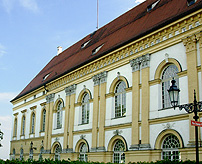 Dachau, a
town to the north of Munich, essentially a suburb of the Bavarian capital
is better known to visitors to Germany for its infamous concentration
camp, now a holocaust museum (see Dachau
Camp Holocaust Museum), but for centuries
before the wars of the 20th Century, Dachau was the one of the country
retreats of the Munich royal court. The Dachau Palace sits on top of
a hill overlooking the city below and Munich beyond, perhaps the least
familiar of the great royal summer houses managed by the Bavarian
palace historical department. The Dachau Palace (Schloss Dachau) was
the first of the summer palaces of the Wittelsbach dynasty, but with
the building of the larger palaces at Schleissheim, lost some of its
status (see Schleissheim Palaces).
Dachau, a
town to the north of Munich, essentially a suburb of the Bavarian capital
is better known to visitors to Germany for its infamous concentration
camp, now a holocaust museum (see Dachau
Camp Holocaust Museum), but for centuries
before the wars of the 20th Century, Dachau was the one of the country
retreats of the Munich royal court. The Dachau Palace sits on top of
a hill overlooking the city below and Munich beyond, perhaps the least
familiar of the great royal summer houses managed by the Bavarian
palace historical department. The Dachau Palace (Schloss Dachau) was
the first of the summer palaces of the Wittelsbach dynasty, but with
the building of the larger palaces at Schleissheim, lost some of its
status (see Schleissheim Palaces).
 The Dachau Palace is not what it once was. A late Gothic castle once
stood on the strategic hilltop, but was replaced by a huge Renaissance
palace of four separate wings surrounding a formal garden built in 1546
to 1579 as a summer residence for Duke Wilhelm IV and his successor Duke
Albrect V.
The Dachau Palace is not what it once was. A late Gothic castle once
stood on the strategic hilltop, but was replaced by a huge Renaissance
palace of four separate wings surrounding a formal garden built in 1546
to 1579 as a summer residence for Duke Wilhelm IV and his successor Duke
Albrect V.
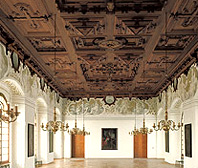
The Elector Max Emanual added to the palace in the 18th Century with a new Baroque facade and great staircase by court architect Joseph Effner who was born in Dachau, but only a hundred years later, three of the four wings of the complex were demolished on the order of King Max Joseph I. What remains today is the long main hall structure, most important for its great banquet hall with one of the most significant Renaissance period wooden coffered ceilings in a German palace, carved by Munich artist Hans Wisruetter.
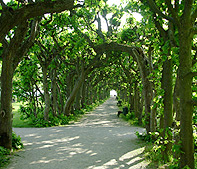 The Dachau
Palace garden which spreads out on a terrace from the palace hall
to the edge
of the hilltop above the Amper River was originally
a walled Renaissance garden of geometric flower and herb beds, but late
replaced with a garden parterre is now a more casual English garden style
and orchard, though a 280 year old pergola of Linden
trees remains. Max Emanual added a "pleasure garden" in the
wooded area next to the court garden with royal amusements of a swing
and bowling, but later allowed to fall into abandonment.
The Dachau
Palace garden which spreads out on a terrace from the palace hall
to the edge
of the hilltop above the Amper River was originally
a walled Renaissance garden of geometric flower and herb beds, but late
replaced with a garden parterre is now a more casual English garden style
and orchard, though a 280 year old pergola of Linden
trees remains. Max Emanual added a "pleasure garden" in the
wooded area next to the court garden with royal amusements of a swing
and bowling, but later allowed to fall into abandonment.
Visiting Dachau Palace
 The Dachau Palace
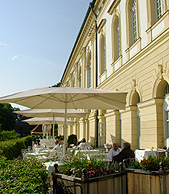
is located in the pretty old town of Dachau, up winding streets from
the main traffic thoroughfare. It has a restaurant on the
lower floor with dining on the terrace overlooking the garden making
for a very pleasant lunch spot in nice weather. The palace is open 9am
to 6pm April thru September and 10am to 4pm October to March, and closed
on Mondays in the winter months. If visiting the palace, the old town
of Dachau is worth spending a bit of time. Just down the hill is the
St Jakob’s Church, one of Bavaria’s many great Baroque churches
(see Baroque Churches of Munich). By rail, the Dachau Palace can be reached
by DB Rail or S2 from Munich, then bus 720 to the Rathaus. Bus service
also runs to the Dachau Internment Camp via the bus terminal at the train
station. There is a car parking lot and the garden has handicapped access
ramp. © Bargain
Travel Europe
The Dachau Palace
is located in the pretty old town of Dachau, up winding streets from
the main traffic thoroughfare. It has a restaurant on the
lower floor with dining on the terrace overlooking the garden making
for a very pleasant lunch spot in nice weather. The palace is open 9am
to 6pm April thru September and 10am to 4pm October to March, and closed
on Mondays in the winter months. If visiting the palace, the old town
of Dachau is worth spending a bit of time. Just down the hill is the
St Jakob’s Church, one of Bavaria’s many great Baroque churches
(see Baroque Churches of Munich). By rail, the Dachau Palace can be reached
by DB Rail or S2 from Munich, then bus 720 to the Rathaus. Bus service
also runs to the Dachau Internment Camp via the bus terminal at the train
station. There is a car parking lot and the garden has handicapped access
ramp. © Bargain
Travel Europe
Best vacation deals compare prices in Bavaria at TripAdvisor
Web Info
Dachau Palace
These articles are copyrighted and the sole property of Bargain Travel Europe and WLPV, LLC. and may not be copied or reprinted without permission.
See Also:
RESIDENCE PALACE - CROWN JEWELS - MUNICH
BMW WORLD - MUSEUM & FACTORY IN MUNICH
BURG TRAUSNITZ MEDIEVAL CASTLE IN LANDSHUT
SCHLOSS NYMPHENBURG PALACE AND GARDENS
JOHANNISBURG
PALACE - ASCHAFFENBURG

