

PORSCHE MUSEUM STUTTGART
Germany's Newest Shrine to Speed and Sports Cars
 For
lovers of the automobile Porsche is a name that
evokes speed and sleek design, on display in full glory at
the new Porsche Museum in Stuttgart. A minimalist futuristic exterior
of angular
lines
in surprise
contrast to the swooping curves for which the world’s most famous
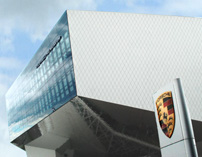
sports car maker is known. The Porsche Museum appears
rather like an alien space ship landing in the north Stuttgart factory
suburb of Zuffenhausen where the German sports marquee has been manufacturing
its cars since 1950, a glistening reflective silver sided box seeming
to hover in the air above the streets, where even the traffic seems to
consist of Porsches. An impressive design idea from Delugan Meissl to
support the entire exhibit above the ground on just three v-shape pillars
housing
the escalators which carry visitors to the museum floors above the glass
walled ground entrance at the Porscheplatz.
For
lovers of the automobile Porsche is a name that
evokes speed and sleek design, on display in full glory at
the new Porsche Museum in Stuttgart. A minimalist futuristic exterior
of angular
lines
in surprise
contrast to the swooping curves for which the world’s most famous
sports car maker is known. The Porsche Museum appears
rather like an alien space ship landing in the north Stuttgart factory
suburb of Zuffenhausen where the German sports marquee has been manufacturing
its cars since 1950, a glistening reflective silver sided box seeming
to hover in the air above the streets, where even the traffic seems to
consist of Porsches. An impressive design idea from Delugan Meissl to
support the entire exhibit above the ground on just three v-shape pillars
housing
the escalators which carry visitors to the museum floors above the glass
walled ground entrance at the Porscheplatz.
Porsche History
 Ferdinand
Porsche, began his career working for a company that made horse carriages
for
the Austria-Hungarian emperors in the 1890’s,
but soon ventured into the new engineering of automobiles, designing
an electric car with Ludwig Lohner in 1898. He worked with automaker
Daimler on the world's first electric-combustion hybrid engine car, before
coming up with the most successful car design ever, the Volks Wagen
(the peoples’ car).
Twenty million of the inexpensive and convenient Type 1 Volkswagen “Beetle” have
been produced (see Volkswagen Wolfsburg), but Ferdinand Porsche as a
designer was fascinated with speed rather than convenience. In
1939, he
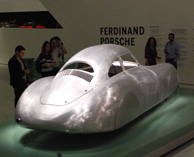
created the Type 64, for a road race from Berlin to Rome, a lightweight
aluminum
body
of elegant
sweeping curves based on the Volkswagen rear air-cooled engine and
chassis. The Type 64 became the genesis for what has become the Porsche
brand
and indeed a fetish for lovers of fast cars.
Ferdinand
Porsche, began his career working for a company that made horse carriages
for
the Austria-Hungarian emperors in the 1890’s,
but soon ventured into the new engineering of automobiles, designing
an electric car with Ludwig Lohner in 1898. He worked with automaker
Daimler on the world's first electric-combustion hybrid engine car, before
coming up with the most successful car design ever, the Volks Wagen
(the peoples’ car).
Twenty million of the inexpensive and convenient Type 1 Volkswagen “Beetle” have
been produced (see Volkswagen Wolfsburg), but Ferdinand Porsche as a
designer was fascinated with speed rather than convenience. In
1939, he
created the Type 64, for a road race from Berlin to Rome, a lightweight
aluminum
body
of elegant
sweeping curves based on the Volkswagen rear air-cooled engine and
chassis. The Type 64 became the genesis for what has become the Porsche
brand
and indeed a fetish for lovers of fast cars.
The Porsche Musuem Exhibits
 The
Porsche Museum presents an orgy of speedy vehicles, with 80 cars on
display on three
levels.
Starting from the bare burnished aluminum chassis of
the Type 64 - one direction examines the pre-1948 history of Ferdinand
Porsche, but the majority of the exhibition levels are devoted to the
sports and racing cars from 1950 onward when the auto-maker was in the
hands of son Ferdinand Anton “Ferry” Porsche, starting
with the first “true” Porsche sports car, the 356, to the
continuing advances of the 911 Carrera Turbo. While other German auto-makers
like
Mercedes or BMW made sedans or even trucks, Porsche has focused almost
entirely on sports cars, with only a brief excursion into Formula One
which never actually competed. and the curiosity of a Porsche tractor,
even Porsche’s
legendary racing car history has been devoted to light-weight aerodynamic
agile, high power-to-weight ratio road
racing and sports cars.
The
Porsche Museum presents an orgy of speedy vehicles, with 80 cars on
display on three
levels.
Starting from the bare burnished aluminum chassis of
the Type 64 - one direction examines the pre-1948 history of Ferdinand
Porsche, but the majority of the exhibition levels are devoted to the
sports and racing cars from 1950 onward when the auto-maker was in the
hands of son Ferdinand Anton “Ferry” Porsche, starting
with the first “true” Porsche sports car, the 356, to the
continuing advances of the 911 Carrera Turbo. While other German auto-makers
like
Mercedes or BMW made sedans or even trucks, Porsche has focused almost
entirely on sports cars, with only a brief excursion into Formula One
which never actually competed. and the curiosity of a Porsche tractor,
even Porsche’s
legendary racing car history has been devoted to light-weight aerodynamic
agile, high power-to-weight ratio road
racing and sports cars.
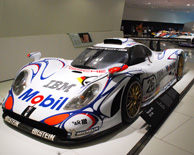 Unlike
the Mercedes Museum on the other side of Stuttgart (see Mercedes-Benz
Museum Stuttgart) where a
visitor starts at the top and winds downward
through history and car design, the Porsche Museum rises upward through
the levels. There are a few exhibits on design and engineering with
films
and cutaway
models,
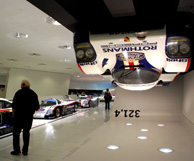
but most of the museum is devoted to the magnificent cars and racing
legends, so sleek while standing static in a museum almost seem as if
flying down a track, while the power of aerodynamic downforce pins a
Rothman's 956 upside down. Porsche’s
dominance of road sports car racing from the Targa Florio to Le
Mans and endurance road racing is in evidence throughout, and celebrated
with
pride
in
Steve
McQueen’s
famed filmic ode to road racing with the special Porsche outfitted with
camera needed to film the actual racing 917s at speed in the movie “Le
Mans”.
An audio guide explains the exhibits
Unlike
the Mercedes Museum on the other side of Stuttgart (see Mercedes-Benz
Museum Stuttgart) where a
visitor starts at the top and winds downward
through history and car design, the Porsche Museum rises upward through
the levels. There are a few exhibits on design and engineering with
films
and cutaway
models,
but most of the museum is devoted to the magnificent cars and racing
legends, so sleek while standing static in a museum almost seem as if
flying down a track, while the power of aerodynamic downforce pins a
Rothman's 956 upside down. Porsche’s
dominance of road sports car racing from the Targa Florio to Le
Mans and endurance road racing is in evidence throughout, and celebrated
with
pride
in
Steve
McQueen’s
famed filmic ode to road racing with the special Porsche outfitted with
camera needed to film the actual racing 917s at speed in the movie “Le
Mans”.
An audio guide explains the exhibits 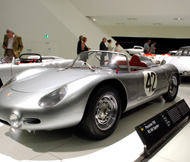 by
the press of the exhibit number, allowing the visitor to wander to wherever
interest leads, rather than
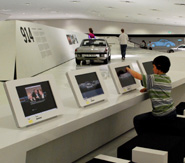
a linear chronology. There are interactive computer stations on the top
floor to explore the Porsche mystique. The throaty throbbing sounds of
Porsche engines can be sampled in the the unique sound cones on the upper
floor. For the real Porsche history minded, the museum has
an historical archive
and
research
library
open
to the
public
on prior arrangement. And perhaps unique among car museums the Porsche
Museum has a glass walled auto mechanic shop where the historical
vehicles of the museum, still sent out for historic racing events
(see Mille
Miglia: Brescia to Rome) are maintained, and private owners
of classic Porsches can have their cars repaired by the factory technicians.
by
the press of the exhibit number, allowing the visitor to wander to wherever
interest leads, rather than
a linear chronology. There are interactive computer stations on the top
floor to explore the Porsche mystique. The throaty throbbing sounds of
Porsche engines can be sampled in the the unique sound cones on the upper
floor. For the real Porsche history minded, the museum has
an historical archive
and
research
library
open
to the
public
on prior arrangement. And perhaps unique among car museums the Porsche
Museum has a glass walled auto mechanic shop where the historical
vehicles of the museum, still sent out for historic racing events
(see Mille
Miglia: Brescia to Rome) are maintained, and private owners
of classic Porsches can have their cars repaired by the factory technicians.
Visiting the Porsche Museum Stuttgart
 The
Porsche Museum has two restaurants,
a coffee bar with view of the workshop, and a souvenir
museum store with models and Porsche gear for kids young and old on the
first level. Museum open hours are 9 to 6 Tuesday to Sunday, closed on
Mondays. The parking garage in pristine Porsche white, is below ground,
entered next to the entrance plaza. Admission is 8€ for adults
and 4€ for
students and seniors, parking is 2€ paid with admission. The Porsche
Museum is easily reached by S-Bahn with its own stop at Porscheplatz,
directly next to
the museum. The Porsche factory showroom is just across the street -
just in case you’d
rather drive a new 911 home than take the tram back. © Bargain
Travel Europe
The
Porsche Museum has two restaurants,
a coffee bar with view of the workshop, and a souvenir
museum store with models and Porsche gear for kids young and old on the
first level. Museum open hours are 9 to 6 Tuesday to Sunday, closed on
Mondays. The parking garage in pristine Porsche white, is below ground,
entered next to the entrance plaza. Admission is 8€ for adults
and 4€ for
students and seniors, parking is 2€ paid with admission. The Porsche
Museum is easily reached by S-Bahn with its own stop at Porscheplatz,
directly next to
the museum. The Porsche factory showroom is just across the street -
just in case you’d
rather drive a new 911 home than take the tram back. © Bargain
Travel Europe
Compare best hotel deals in Stuttgart on TripAdvisor
Web Info
Porsche Museum
These articles are copyrighted and the sole property of Bargain Travel Europe and WLPV, LLC. and may not be copied or reprinted without permission.
See Also:
BMW MUSEUM & TECHNOLOGY WORLD - MUNICH

