


HARLECH
CASTLE - SNOWDONIA
Edward I’s Toughest Wales Coast Fortress
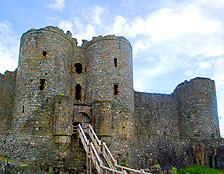 It stands stark on a steep hillside, on watch over the wind swept northeast coast of Wales, one of the most striking of fortified castles. Harlech Castle was part of Edward I’s “Iron Ring” of fortresses meant to control the hilly lands of North Wales, one of four magnificent castles on the northwest shores of the Welsh Snowdonia region. Along with its brethren Caernarvon, Conwy and Beaumaris, Harlech Castle is a World Heritage listed site for its historical significance and its lasting architecture, one on the purest of fortresses.
 Harlech
Castle is most identified for its high concentric walls in a symmetrical
near
square with corner towers and massive “double
D” gatehouse. The castle at Harlech was built over seven years
beginning in 1283 on the site of a earlier fortified position. As it
stands today, it is landlocked, with the sea in the distance, due mostly
to later land reclamations, but in the 13th Century the water at high
tide reached to the bottom of the cliff where the Snowdonia coastal road
now runs below. A stone stairway from the low coastal side called the “way
from the sea” was the secret to the castle’s survival, allowing
re-supply from the water. No castle is impregnable, but Harlech was about
as close as castles get. It was never breached during the time of Edward "Longshanks",
arguably England's most successful Plantagenet king (see Ripley
Castle Boarshead),
if subduing lands and adding to holdings is
Harlech
Castle is most identified for its high concentric walls in a symmetrical
near
square with corner towers and massive “double
D” gatehouse. The castle at Harlech was built over seven years
beginning in 1283 on the site of a earlier fortified position. As it
stands today, it is landlocked, with the sea in the distance, due mostly
to later land reclamations, but in the 13th Century the water at high
tide reached to the bottom of the cliff where the Snowdonia coastal road
now runs below. A stone stairway from the low coastal side called the “way
from the sea” was the secret to the castle’s survival, allowing
re-supply from the water. No castle is impregnable, but Harlech was about
as close as castles get. It was never breached during the time of Edward "Longshanks",
arguably England's most successful Plantagenet king (see Ripley
Castle Boarshead),
if subduing lands and adding to holdings is 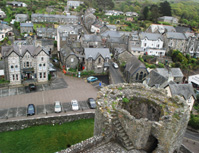 the
measure, with his concept that his castle fortresses should have their "feet
in the sea".
Harlech survived sieges of eight months, was taken briefly in 1404, regained
by Henry V when still a young Prince Harry. Harlech's formidability was
famously memorialized in the song “Men of Harlech” for withstanding
a siege of seven years and the last Lancaster castle to fall in the War
of the Roses in 1468. Harlech’s last hurrah as a castle stronghold
was in the English Civil war, again the last castle to succumb to the
Cromwellian forces, not surrendered until the Ides of March in 1647,
a full year after Charles I had been captured, and partly destroyed to
end its strategic purpose.
the
measure, with his concept that his castle fortresses should have their "feet
in the sea".
Harlech survived sieges of eight months, was taken briefly in 1404, regained
by Henry V when still a young Prince Harry. Harlech's formidability was
famously memorialized in the song “Men of Harlech” for withstanding
a siege of seven years and the last Lancaster castle to fall in the War
of the Roses in 1468. Harlech’s last hurrah as a castle stronghold
was in the English Civil war, again the last castle to succumb to the
Cromwellian forces, not surrendered until the Ides of March in 1647,
a full year after Charles I had been captured, and partly destroyed to
end its strategic purpose.
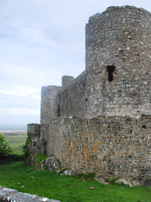 Harlech
Castle is attended by the small hamlet village of Harlech, approached
by a
winding
narrow little road from the main coast highway. The castle
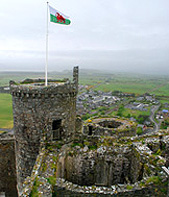
itself is a stark semi-ruin of limestone. Atop the gatehouse with its
deadly murder holes, reached from a wooden stairway replacing the long
vanished draw and portcullis, provides some incredible views of the Welsh
coast and mount Snowdonia. Some displays within the walls provide a history
of the castle and its construction. A parking lot is immediately in front
of the might gatehouse which faces the landward side. The town of Harlech
has a few shops of interest and the Harlech
Castle Hotel is just opposite
with rather reasonable prices and there is a small amusement hall with
games and activities for kids and adults is
nearby.
Harlech
Castle is attended by the small hamlet village of Harlech, approached
by a
winding
narrow little road from the main coast highway. The castle
itself is a stark semi-ruin of limestone. Atop the gatehouse with its
deadly murder holes, reached from a wooden stairway replacing the long
vanished draw and portcullis, provides some incredible views of the Welsh
coast and mount Snowdonia. Some displays within the walls provide a history
of the castle and its construction. A parking lot is immediately in front
of the might gatehouse which faces the landward side. The town of Harlech
has a few shops of interest and the Harlech
Castle Hotel is just opposite
with rather reasonable prices and there is a small amusement hall with
games and activities for kids and adults is
nearby.
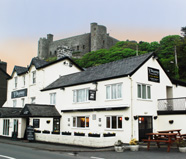 Harlech Castle overlooks the Royal St David’s Golf Course and directly below on the main road is a restaurant pub with rooms
accommodation, the Y
Branwen Hotel and Brasserie popular
with locals, tourists and Snowdonia cycling enthusiasts. Many houses
in the
area rent out as holiday homes and B&B's (see Snowdonia
Farmhouse B&B). Other nearby activities are the coastal
beaches, the Village of Portmeirion (see Prisoner
Village Portmeirion), slate mines and steam rail trains
(see Heritage
Railways Porthmadog).
The other Edward I Iron Ring castles of North Wales
are easily reached in a day by car. © Bargain
Travel Europe
Harlech Castle overlooks the Royal St David’s Golf Course and directly below on the main road is a restaurant pub with rooms
accommodation, the Y
Branwen Hotel and Brasserie popular
with locals, tourists and Snowdonia cycling enthusiasts. Many houses
in the
area rent out as holiday homes and B&B's (see Snowdonia
Farmhouse B&B). Other nearby activities are the coastal
beaches, the Village of Portmeirion (see Prisoner
Village Portmeirion), slate mines and steam rail trains
(see Heritage
Railways Porthmadog).
The other Edward I Iron Ring castles of North Wales
are easily reached in a day by car. © Bargain
Travel Europe
Find best hotel and travel deals in North Wales on TripAdvisor
Web Info
Harlech Castle
These articles are copyrighted and the sole property of Bargain Travel Europe and WLPV, LLC. and may not be copied or reprinted without permission.
SEE ALSO:
CONWY
CASTLE - TURRETED MASTERWORK
BEAUMARIS
CASTLE - COURTHOUSE & GAOL
CAERNARFON CASTLE - PRINCES AND FUSILIERS
CASTLE HOTEL CONWY- CASTLE VIEW & SHAKESPEARE
HISTORIC WALLED CITY OF CHESTER

