
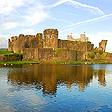


ST
DAVID’S BISHOP’S
PALACE AND CATHEDRAL
Great Religious History in Wales Smallest Town
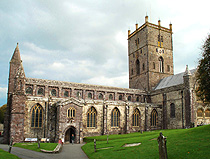 St David’s, the town, is traditionally the smallest city in the United Kingdom and the only one completely located in a national park, but whose significance in the religious history of Wales is indeed outsized. Lying on the peninsula of the westernmost point of Wales surrounded by the scenic coastline of the Pembrokeshire Coast National Park and named for the patron saint of Wales, St David's is home to the magnificent medieval ruins of the St David’s Bishops Palace, St David’s Cathedral and the St. Non well and chapel ruins. Legend has it Saint David was born around the year 500 during a stormy night on the coast to where his mother Saint Non has escaped after being seduced by a local Welsh Chieftain.
 A well sprung up to provide fresh water during the storm on the night of St David’s birth. St David later founded a monastery about a mile from the spot of his birth. The Cathedral of St David was first begun construction in 1182 by the Bishop Peter de Leia. The Relics of St David and St Justinian were both held in a shine at the cathedral, drawing both William the Conqueror, Henry II and King Edward I came to St David’s to pray at the shrine, until the relics were later removed during the reformation.
St David's Bishop's Palace
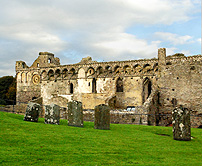 St David’s became one of the most important pilgrimage spots of the Middle Ages when Pope Calixtus II issued a decree that two pilgrimages to St David's were equal to one to Rome, and three visits were equal to a pilgrimmage to Jerusalum. This made the Bishops of St David’s very wealthy from the “tourist” trade of visiting pilgrims in the 13th and 14th Centuries, making St David’s the ecclesiastical religious capital of Wales. The Bishops of St David, principally the Bishop Henry de Gower under King Edward III, built a great stonework palace in the river valley below the cathedral – the Cathedral Close - with the major constuction from 1328-1347.
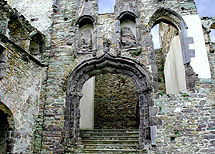 The fortified palace castle, was one of the grandest of the day in the British Isles, and like the Rock of Cashel in southern Ireland (see Rock of Cashel), a clear representation of the political position and secular power of the bishops of the Middle Ages. The palace was abondoned and mostly laid to ruin by the 17th Century. What remains are full sections of the walls of pre-gothic Romanesque arches and gargoyles, with unique checkerboard patterns outlining the great hall, the Bishops' Solar and the quite impressively massive Bishop’s bedroom looking out on the cathedral. The undercrofts hold a display of the palace's construction and history of the bishops. St David's Bihop's Palace is administerd by Cadw, the government heritage organization. Outdoor music and theater performances are somethimes held in the open ground of the palace.
St David's Cathedral
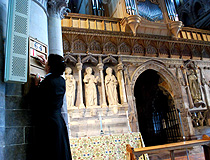 The Cathedral of St
David’s is actually the fourth church to be
built on the spot where St David founded his monastic settlement. The
romanesque Cathedral from the 12th Century was nearly destroyed by Oliver
Cromwell during the Puritan Commonwealth and restored in meticulous detail
by Welsh architect John Nash in 1793 and later by Geroge Gilbert Scott.
The town which surrounded the church lost its importance over the centuries
and returned to its present small village state.
The Cathedral of St
David’s is actually the fourth church to be
built on the spot where St David founded his monastic settlement. The
romanesque Cathedral from the 12th Century was nearly destroyed by Oliver
Cromwell during the Puritan Commonwealth and restored in meticulous detail
by Welsh architect John Nash in 1793 and later by Geroge Gilbert Scott.
The town which surrounded the church lost its importance over the centuries
and returned to its present small village state. 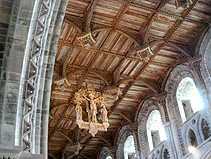 The Cathedral of St
David has been holding services for over 1,000 years. The most outstanding
features of the structure are the magnificent oak carved ceilings ceilings,
bare and intricate in the nave and painted in the Choir and Presbytery.
The shrine of St David remains in an unadorned form with the relics long
gone. The cathedral treasures of rings and crosses of the medieval bishops,
illuminated manuscripts, cloth and silver can be seen in the Cathedral
Treasury. The Cathedral gets no public money. There is no required admission,
but a donation of £3 is suggested, with kids for free.
The Cathedral of St
David has been holding services for over 1,000 years. The most outstanding
features of the structure are the magnificent oak carved ceilings ceilings,
bare and intricate in the nave and painted in the Choir and Presbytery.
The shrine of St David remains in an unadorned form with the relics long
gone. The cathedral treasures of rings and crosses of the medieval bishops,
illuminated manuscripts, cloth and silver can be seen in the Cathedral
Treasury. The Cathedral gets no public money. There is no required admission,
but a donation of £3 is suggested, with kids for free.
St Non's Well and Chapel
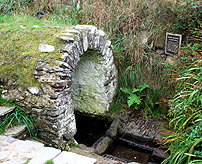 The
legendary Saint Non's Well which brought pilgrims for its reputed healing
waters and the ruins of the small ancient chapel nearby, is about
a 10-15 minute walk or 3 minute drive from the town. Set in a natural
backdrop overlooking the Pembrokeshire Coast Path and St Brides Bay
and now watched over
by
a shrine to the
Virgin Mary added in more current times, the view is pretty much what
it would have been
The
legendary Saint Non's Well which brought pilgrims for its reputed healing
waters and the ruins of the small ancient chapel nearby, is about
a 10-15 minute walk or 3 minute drive from the town. Set in a natural
backdrop overlooking the Pembrokeshire Coast Path and St Brides Bay
and now watched over
by
a shrine to the
Virgin Mary added in more current times, the view is pretty much what
it would have been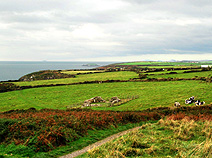 following that stormy night. The
Cambrian cliffs along
the shoreline make this a popular spot for hikers along the coastal path
kayakers from the beaches below. There is no cost to get to the well,
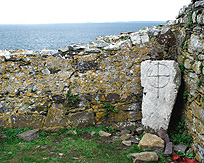
except perhaps for a coin tossed in. The chapel ruins with a single
hand-scratched
crucifix
stone is accessable in the field inhabited by cows. Near the well and
chapel ruins are a private religious retreat and the manor house Warpool
Court Hotel with lovely views of the chapel field and sea.
following that stormy night. The
Cambrian cliffs along
the shoreline make this a popular spot for hikers along the coastal path
kayakers from the beaches below. There is no cost to get to the well,
except perhaps for a coin tossed in. The chapel ruins with a single
hand-scratched
crucifix
stone is accessable in the field inhabited by cows. Near the well and
chapel ruins are a private religious retreat and the manor house Warpool
Court Hotel with lovely views of the chapel field and sea.
If the histroic old religious spots aren't enough for a visit to St David's, the walks along the coast and outdoor activities of the National Park are the main attraction along with boat tours to Ramsey Island, seal and whale watching, and a couple of nearby woolen mills. The tourist center is just to the northeast along the main road as you enter the village, just across from The Grove Hotel and Restaurant. © Bargain Travel Europe
Compare best hotel deals in St Davids on TripAdvisor
Web Info
Cadw Wales
These articles are copyrighted and the sole property of Bargain Travel Europe and WLPV, LLC. and may not be copied or reprinted without permission.
SEE ALSO:
LLANGYFELACH PARISH ST DAVID'S CHURCH
DINEFWR CASTLE PARK AND NEWTON HOUSE
CONWY
CASTLE
FISHGUARD MANOR
TOWNHOUSE B&B
MERLIN'S
HILL - WORKING FARM B&B - CARMARTHEN

