
WHERE
MOZART DIED – VIENNA
Mozart - Murder, Mystery and Free Masons
 Where did Mozart die? The short answer, RauhensteinGasse 4, Vienna. How did Mozart die? A mystery wrapped in conspiracy theory with a little soap opera drama thrown in the mix. The most famous composer of the Baroque era died at the age of 35 in the early morning hours of December 5, 1791. He had suffered a series of health problems throughout his relatively short life, including smallpox and typhoid fever. After supervising a performance of his new opera La Clamenza di Tito in Prague, he began to feel ill. He returned to Vienna and grew progressively worse while working on a commissioned Requiem. According to his wife, Constanze, Mozart’s “indisposition increased visibly and made him gloomily depressed”. He began to speak of death, was occasionally delusional and declared he was writing the Requiem for himself adding, “I am sure I have been poisoned and cannot rid myself of this idea." He took to bed on November 20, suffering from swelling, pain and vomiting and virtually never got up again. His body swelled so much he could no longer sit up in bed, or even move on his own, until death came with a last explosive wretch of brown bile at 1 AM on the 5th of December. Mozart was struggling with poverty at the time of his death, due mostly to his heavy gambling, and was buried on December 7 in an unmarked common pauper’s grave in the St. Marx Cemetery just outside the walls of Vienna.
Mozart Murder Theories
 Mozart’s statements about his belief in being poisoned has raised a raging controversy about how he really died and whether he was murdered. Many are familiar with the play Amadeus by Peter Shaffer and the movie version exploring the long held idea that the genius composer was poisoned by royal court chorale master Antonio Salieri. Salieri was indeed demonstrably close to Mozart. Salieri, three other musicians and Mozart’s patron Baron Gottfried van Swieten, who’d made the funeral arrangements, were the only attendees at the funeral of the greatest composer of the time. Salieri was accused of the crime in his lifetime by innuendo and suffered under the accusation until his own death. But this is not the only salacious murder conspiracy theory.
 With the state of medicine at the time, the true cause of Mozart’s death is near impossible to determine. The entry in the parish register states that he died of a "severe milary fever", which describes a number of diseases marked by the symptoms of bumps on the skin. Some blame Mozart’s death on his physician for malpractice, though in the late 1700s, that was probably more true than not, in general. One theory holds that Mozart poisoned himself with a common patent medicine remedy of the time containing antimony (see Swiss
Pharmacy Museum), a metallic sulfide now used in car batteries, which was thought to clear the bowels - or by taking Mercury to cure Syphilis. An experts panel recently opined than he simply died of the complications of Rheumatic Fever. The real cause of Mozart’s death will never be known, his body cannot be exhumed and the hair locks that survive (see Mozart's
Birth
House Salzburg) are from an earlier time in his life.
With the state of medicine at the time, the true cause of Mozart’s death is near impossible to determine. The entry in the parish register states that he died of a "severe milary fever", which describes a number of diseases marked by the symptoms of bumps on the skin. Some blame Mozart’s death on his physician for malpractice, though in the late 1700s, that was probably more true than not, in general. One theory holds that Mozart poisoned himself with a common patent medicine remedy of the time containing antimony (see Swiss
Pharmacy Museum), a metallic sulfide now used in car batteries, which was thought to clear the bowels - or by taking Mercury to cure Syphilis. An experts panel recently opined than he simply died of the complications of Rheumatic Fever. The real cause of Mozart’s death will never be known, his body cannot be exhumed and the hair locks that survive (see Mozart's
Birth
House Salzburg) are from an earlier time in his life.
Freemasons and the Bloody Rough Stone
 The most sensational conspiracy theories about Mozart’s demise was his connection to the Freemasons. Mozart had become a mason in 1784 and at the time of his death was working on one of several music compositions for the secretive organization. Shortly before his death, Constanze tried to cheer her husband of his dark thoughts of impending doom by encouraging him to put aside the Requem and work instead on a cantata, the Freimaurer,
to celebrate the opening a new Masonic Temple for his lodge. One
theory holds that the Freemasons had Mozart killed because his
opera The Magic
Flute drew on secrets of the Masonic Rituals which members were bound on pain of death not to reveal. And he certainly owed much of his gambling debts to his masonic brethren. The other masonic related theory is less conspiratorial, but more human and salacious than either Salieri’s professional envy or Freemasonic evil. Mozart was a notorious womanizer and a rumor was afoot about Vienna that Mozart had a dalliance with the 23 year old wife of a fellow of his own Masonic lodge, Franz Hofdemel. This was given public credence by contemporary and fellow lodge member Ludwig Von Beethoven (see Schwartzen
Kameel)
who refused to play in the presence of the discredited young woman. The day after Mozart’s funeral, Hofdemel apparently brutally attacked his wife Magdelena with a straight razor and then cut is own throat. His wife was found alive, lying in pool of blood and 5 months pregnant. She was revived and gave birth to a boy she named after both her dead husband and Mozart, giving life to the whispered theory that Hofdemel poisoned Mozart after discovering the affair, before trying to kill his wife and committing suicide.
The most sensational conspiracy theories about Mozart’s demise was his connection to the Freemasons. Mozart had become a mason in 1784 and at the time of his death was working on one of several music compositions for the secretive organization. Shortly before his death, Constanze tried to cheer her husband of his dark thoughts of impending doom by encouraging him to put aside the Requem and work instead on a cantata, the Freimaurer,
to celebrate the opening a new Masonic Temple for his lodge. One
theory holds that the Freemasons had Mozart killed because his
opera The Magic
Flute drew on secrets of the Masonic Rituals which members were bound on pain of death not to reveal. And he certainly owed much of his gambling debts to his masonic brethren. The other masonic related theory is less conspiratorial, but more human and salacious than either Salieri’s professional envy or Freemasonic evil. Mozart was a notorious womanizer and a rumor was afoot about Vienna that Mozart had a dalliance with the 23 year old wife of a fellow of his own Masonic lodge, Franz Hofdemel. This was given public credence by contemporary and fellow lodge member Ludwig Von Beethoven (see Schwartzen
Kameel)
who refused to play in the presence of the discredited young woman. The day after Mozart’s funeral, Hofdemel apparently brutally attacked his wife Magdelena with a straight razor and then cut is own throat. His wife was found alive, lying in pool of blood and 5 months pregnant. She was revived and gave birth to a boy she named after both her dead husband and Mozart, giving life to the whispered theory that Hofdemel poisoned Mozart after discovering the affair, before trying to kill his wife and committing suicide.
Where Mozart Died
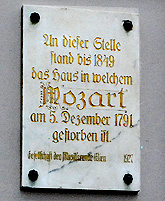
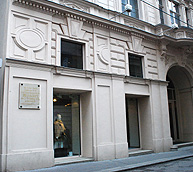
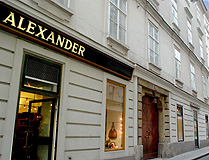
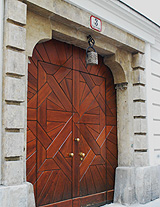
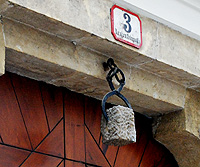 The truth behind the real cause of the death of Mozart will never be known for sure, and the actual building where he died was torn down in 1849. The lodging apartments where Mozart composed and breathed his last breath was located in the Rauhensteingasse (which means Rough Stone Alley), Number 4, a block from the main shopping street of Vienna, the Neuermarkt, two blocks from St Stephens Cathedral. At the spot, now stands a 19th Century building which currently houses a leather goods shop called The World of Mozart, having little to do with the composer other than location and clever marketing. On the wall is a plaque placed in 1927 with the legend in German “An dieser stelle stand bis 1849 das haus im welchem Mozart am 5. Dezember 1791 gestorben ist.” translated “On this spot until 1849 stood the house where Mozart Died”. And more curiously, right across the street, not marked by a plaque but still standing since that late winter night of 1791 is the real building where Mozart’s Masonic Lodge met, Rauhensteingasse Number 3, near the corner of Ballgasse. The building houses another fashion store called Alexander's but you can recognize the historic building by the Masonic symbol of the hanging rough stone over the arched doorway. © Bargain
Travel Europe
The truth behind the real cause of the death of Mozart will never be known for sure, and the actual building where he died was torn down in 1849. The lodging apartments where Mozart composed and breathed his last breath was located in the Rauhensteingasse (which means Rough Stone Alley), Number 4, a block from the main shopping street of Vienna, the Neuermarkt, two blocks from St Stephens Cathedral. At the spot, now stands a 19th Century building which currently houses a leather goods shop called The World of Mozart, having little to do with the composer other than location and clever marketing. On the wall is a plaque placed in 1927 with the legend in German “An dieser stelle stand bis 1849 das haus im welchem Mozart am 5. Dezember 1791 gestorben ist.” translated “On this spot until 1849 stood the house where Mozart Died”. And more curiously, right across the street, not marked by a plaque but still standing since that late winter night of 1791 is the real building where Mozart’s Masonic Lodge met, Rauhensteingasse Number 3, near the corner of Ballgasse. The building houses another fashion store called Alexander's but you can recognize the historic building by the Masonic symbol of the hanging rough stone over the arched doorway. © Bargain
Travel Europe
Find best hotel and travel deals in Vienna on TripAdvisor
Web Info
Vienna Tourism
These articles are copyrighted
and the sole property of Bargain Travel Europe and WLPV, LLC. and
may not be copied or reprinted without permission.
SEE ALSO:
TRADITIONAL VIENNA CAFÉS & CONFECTION
SACHER TORTE AND THE CAFÉ LIFE
SIGMUND FREUD MUSEUM IN VIENNA
MOZART GRAVES ST SEBASTIEN SALZBURG
MOZARTHAUS - LEOPOLD MOZART - AUGSBURG

