
MAD
KING LUDWIG'S PLEASURE PALACE
Rococo Schloss Linderhof & Grotto
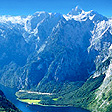
 The father built a country and the son built houses. King Maximillian II of Bavaria would take his young son Ludwig on hunting trips into the Bavarian Ammergau Alps where he had his country residence, the "Königshäuschen" at Schwangau. A master politician as well as hereditary king, Maximillian II had taken a collection of fractious Bavarian fiefdoms and formed them into a modern successful thriving state. When his son, born at the summer palace in Munich
(see Nymphenburg
Palace) came to the throne, he saw himself not unlike the French “sun-king” Louis XIV, an absolute monarch who needed palaces to represent his power and glorious estate. The first country palace built by Ludwig II was Linderhof, a reconstruction from his father’s earlier hunting lodge into a magnificent yet “intimate” personal monument to his royal self-image.
The father built a country and the son built houses. King Maximillian II of Bavaria would take his young son Ludwig on hunting trips into the Bavarian Ammergau Alps where he had his country residence, the "Königshäuschen" at Schwangau. A master politician as well as hereditary king, Maximillian II had taken a collection of fractious Bavarian fiefdoms and formed them into a modern successful thriving state. When his son, born at the summer palace in Munich
(see Nymphenburg
Palace) came to the throne, he saw himself not unlike the French “sun-king” Louis XIV, an absolute monarch who needed palaces to represent his power and glorious estate. The first country palace built by Ludwig II was Linderhof, a reconstruction from his father’s earlier hunting lodge into a magnificent yet “intimate” personal monument to his royal self-image.
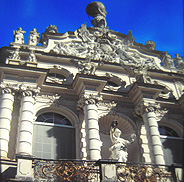
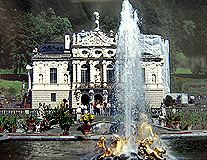 Begun in 1868 and built in rococo opulence of gilt gold in almost every nook and corner, the palace of Linderhof was Ludwig II’s favorite escape, and the only one of his planned palaces actually completed during his lifetime. Its inspiration taken from Versailles, the hall of mirrors dazzles with echoes of reflected golden candelabras. King Ludwig had planned a much grander palace for the location, with a Byzantine design, but his building projects took him elsewhere. He would later build a more exacting replica of Louis' country palace, the Herrenchiemsee Palace on Lake Chiemsee on the other side of Bavaria, and also his more famous medieval revival castle Neuschschwanstein (see Ludwig's
Fantasy Castle Neuschwanstein)
from which Walt Disney got the inspiration for his Sleeping Beauty
Castle.
Begun in 1868 and built in rococo opulence of gilt gold in almost every nook and corner, the palace of Linderhof was Ludwig II’s favorite escape, and the only one of his planned palaces actually completed during his lifetime. Its inspiration taken from Versailles, the hall of mirrors dazzles with echoes of reflected golden candelabras. King Ludwig had planned a much grander palace for the location, with a Byzantine design, but his building projects took him elsewhere. He would later build a more exacting replica of Louis' country palace, the Herrenchiemsee Palace on Lake Chiemsee on the other side of Bavaria, and also his more famous medieval revival castle Neuschschwanstein (see Ludwig's
Fantasy Castle Neuschwanstein)
from which Walt Disney got the inspiration for his Sleeping Beauty
Castle.
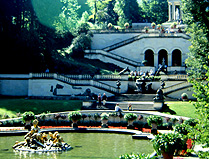
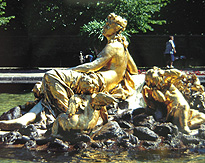
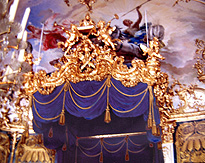 King Ludwig would stay up through the nights and sleep in the day, so his bedroom took prominence as his place of “work”, with appropriate homages to his French sun king idol on the purple and gold drapings of his massive bed. The formal gardens of Linderhof are some of the most beautiful in southern Germany, fronted by the Naiad Fountain where water nymphs gambol amid the waters of the high spouting fountain, surrounded by moorish style pavilions, so popular among the royal courts at the time.
 Linderhof is perhaps most famous for the “Grotto”, an artificial creation based on an illustration from a scene in Wagner’s “Tannhauser”. The grotto was illuminated in changing colors and Ludwig liked to be rowed across the water in a golden shell-shaped boat. It might be argued perhaps that “Mad” Ludwig’s extravagant spending on his palace projects, expressing his own God-granted monarchical right rather than focusing on the prosperity of his people, might be one step on the march to the end of monarchy after WWI and the following rise of Nazism, inspiring Hitler’s Wagnerian ideas of racial destiny, but it cannot be denied King Ludwig II’s schloss building left behind a boon to modern day tourism (see Museum of Bavarian Kings).
Visiting Schloss Linderhof and Grotto
 The Linderhof Palace is open daily from 9am to 6pm from late-March to mid-October and 10am to 4pm from October to April. The Grotto is closed in the winter months. Visiting the interior of the Palace and Grotto are only with Guided Tours. Admission prices are €8.50 for adults, €7.50 for students and seniors. Admission to the park buildings, the Moorish Kiosk, Moroccan House, Hunding's Hut, and Royal Lodge is €5. A combination ticket for all of King Ludwig’s Palaces is available for €24.
Visits to the “Mad Ludwig” castles of Schloss Linderhof and Schloss Neuschwanstein can be made with regular bus tours from Munich (see Munich Sight-Seeing Tours) which can be arranged through most hotels and the tourism offices. By car Linderhof is about an hour drive from Munich, and Neuschwanstein is about 40 minutes from Linderhof at Schwangau with a little dip into Austria, sure you can take a bus tour, but a drive through the beautiful alpine countryside of Bavaria, dotted with gingerbread lodgings is why God invented rental cars. The Ettal Abbey Basilica monastery (see Ettal Abbey Baroque Bavaria) is a short drive away though Oberammergau, the home of the famous Passion Play. © Bargain Travel Europe
Best
vacation deals in Bavaria on Tripadvisor
These articles are copyrighted
and the sole property of Bargain Travel Europe and WLPV, LLC. and
may not be copied or reprinted without permission.
SEE
ALSO:
MURNAU
CASTLE ART MUSEUM
KALTENBERG
KNIGHTS TOURNAMENT
MUNICH'S
ENGLISCHER GARTEN
WINE
AND SAUSAGE FESTIVAL - GERMAN WINE ROAD
HOTEL LUDWIG VON BAYER - ETTAL ABBEY

