

CHATEAU
FONTAINEBLEAU
Emperor Napoleon and France’s Great Royal Palace
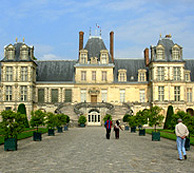 Perhaps
lesser known and farther from Paris than the Versailles Palace, the
Chateau of Château de Fontainebleau had been a residential castle
of French kings since the 12th Century. Fontainebleau is the only royal
chateau in France to have been continuously inhabited for seven centuries.
The first recorded reference in a royal charter dates back to 1137,
the year Louis VII, known as Louis the Younger ascended to the throne
and the castle complex was expanded in the reign of Charles VII, the
medieval King of France of the 15th Century. The current massive royal
palace with over 1500 rooms and extensive gardens was constructed in
the 16th Century and extensively refurbished by the resident now most
associated with it, Napoleon Bonaparte I, first Life Consul and Emperor
of France. It was from Fontainebleau that Napoleon abdicated in 1814,
before his return from Elba in 1815 for his last power trip (see Route
Napoleon). The chateau building and formal garden grounds
provide an impressive glimpse into royal and imperial lifestyle in
the town of Fontainebleau, surrounded by a thick forest, about an hour
south of Paris where the Seine River dips before flowing to the capital
city.
Perhaps
lesser known and farther from Paris than the Versailles Palace, the
Chateau of Château de Fontainebleau had been a residential castle
of French kings since the 12th Century. Fontainebleau is the only royal
chateau in France to have been continuously inhabited for seven centuries.
The first recorded reference in a royal charter dates back to 1137,
the year Louis VII, known as Louis the Younger ascended to the throne
and the castle complex was expanded in the reign of Charles VII, the
medieval King of France of the 15th Century. The current massive royal
palace with over 1500 rooms and extensive gardens was constructed in
the 16th Century and extensively refurbished by the resident now most
associated with it, Napoleon Bonaparte I, first Life Consul and Emperor
of France. It was from Fontainebleau that Napoleon abdicated in 1814,
before his return from Elba in 1815 for his last power trip (see Route
Napoleon). The chateau building and formal garden grounds
provide an impressive glimpse into royal and imperial lifestyle in
the town of Fontainebleau, surrounded by a thick forest, about an hour
south of Paris where the Seine River dips before flowing to the capital
city.
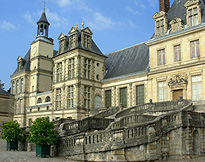 The
Renaissance era rooms retain their unique fresco and stucco art by
Italian artists Rosso and Primaticcio. The apartments of the French
monarchs, antechambers, drawing rooms and throne room illustrate all
the pomp and splendor of a French royal court without the over-the-top
rococo frippery of Versailles. When Napoleon took up residence in 1804
he had several of the interior chambers refurbished for his own private
use, bedchamber, office and other apartments, including a separate
one for Josephine, for when he wanted to be alone with his grand designs
on world conquest. Four drawing rooms were later reconstructed in 1863
by Napoleon III for his wife, Empress Eugenie, for her collection of
oriental art in the Chinese Museum known as the Chinese Drawing Room.
The
Renaissance era rooms retain their unique fresco and stucco art by
Italian artists Rosso and Primaticcio. The apartments of the French
monarchs, antechambers, drawing rooms and throne room illustrate all
the pomp and splendor of a French royal court without the over-the-top
rococo frippery of Versailles. When Napoleon took up residence in 1804
he had several of the interior chambers refurbished for his own private
use, bedchamber, office and other apartments, including a separate
one for Josephine, for when he wanted to be alone with his grand designs
on world conquest. Four drawing rooms were later reconstructed in 1863
by Napoleon III for his wife, Empress Eugenie, for her collection of
oriental art in the Chinese Museum known as the Chinese Drawing Room.
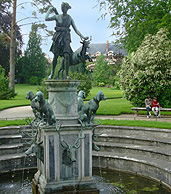 The
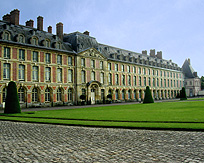
chateau castle of Fontainebleau is surrounded by a hundred acres of
parkland, courtyards and gardens of walks and fountains. The Oval Courtyard
is the oldest part of the castle with a remaining 12th Century square
keep, entered through the massive baroque Dauphine Gate. Other courtyards
and gardens were added by Louis XV, Francois I and Louis XIV, with
the latter’s Grand Parterre, designed by his Versailles landscape
architect, the largest formal garden in France with 45,000 plants blooming
in its flowerbeds every spring.
The
chateau castle of Fontainebleau is surrounded by a hundred acres of
parkland, courtyards and gardens of walks and fountains. The Oval Courtyard
is the oldest part of the castle with a remaining 12th Century square
keep, entered through the massive baroque Dauphine Gate. Other courtyards
and gardens were added by Louis XV, Francois I and Louis XIV, with
the latter’s Grand Parterre, designed by his Versailles landscape
architect, the largest formal garden in France with 45,000 plants blooming
in its flowerbeds every spring.
Napoleon Museum at the Petit Apartments
 For
Napoleon Bonaparte fans, the Napoleon I Museum in the Fontainebleau
Chateau has several rooms displaying memorabilia of Napoleon and his
family during his reign as Emperor (1804-1814), the second empire.
The collection includes his coronation robe and sword, his cocked hat
and a campaign tent along with other items and portraits of his second
wife Marie-Louise, the Archduchess of Austria, and his son, Napoleon
II, known as the King of Rome from birth, though he never actually
went there.
For
Napoleon Bonaparte fans, the Napoleon I Museum in the Fontainebleau
Chateau has several rooms displaying memorabilia of Napoleon and his
family during his reign as Emperor (1804-1814), the second empire.
The collection includes his coronation robe and sword, his cocked hat
and a campaign tent along with other items and portraits of his second
wife Marie-Louise, the Archduchess of Austria, and his son, Napoleon
II, known as the King of Rome from birth, though he never actually
went there.
Fontainebleau Ville and Forest
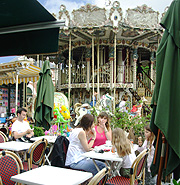 The
town of Fontainebleau which grew around the palace was a popular tourism
spot for upper class Parisians in centuries past and the rich forest
landscapes around, popular with French landscape painters sometimes
called the "savage" school. The nearby village of Barbizon
became known as the "village of painters" in the 1800's.
The town center of Fontainebleau can be crowded with tourists at peak
times, but provides a number of museums and other sites to visit along
with charming restaurants. There is even an ornate merry-go-round among
the sidewalk ice creameries and local cheese shops where the local
soft creamy "Le Fontainebleau" variety can be sampled. And
if real horses are of interest there are two well-known equestrian
centers, the Hippodrome de la Solle and the Grand Parquet.
The
town of Fontainebleau which grew around the palace was a popular tourism
spot for upper class Parisians in centuries past and the rich forest
landscapes around, popular with French landscape painters sometimes
called the "savage" school. The nearby village of Barbizon
became known as the "village of painters" in the 1800's.
The town center of Fontainebleau can be crowded with tourists at peak
times, but provides a number of museums and other sites to visit along
with charming restaurants. There is even an ornate merry-go-round among
the sidewalk ice creameries and local cheese shops where the local
soft creamy "Le Fontainebleau" variety can be sampled. And
if real horses are of interest there are two well-known equestrian
centers, the Hippodrome de la Solle and the Grand Parquet.
Get Mary Shelley Frankenstein Diaries Audio Book Free w/Trial
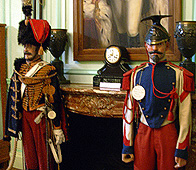 For
even more Napoleon, the Musee Napoleonien, also known as the Museum
of Military History of Fountainbleu, is entirely separate from the
Fontainbleau Palace, located a few blocks away in a smaller in town
chateau on Rue Saint-Honore (see Musee
Napoleonien), with rooms of military uniforms, dressed
on figures in tableau, equipment and figurines, mostly from the Napoleonic
period (see Napoleon
Tomb Invalides and Waterloo
Museums) Other curious historical museums in town are
the National Museum of Prisons housed in the former Fontainebleau Prison
and the French National Archives where history or genealogy can be
researched. These latter two require contacting the Tourist Office
for appointments or group tours.
For
even more Napoleon, the Musee Napoleonien, also known as the Museum
of Military History of Fountainbleu, is entirely separate from the
Fontainbleau Palace, located a few blocks away in a smaller in town
chateau on Rue Saint-Honore (see Musee
Napoleonien), with rooms of military uniforms, dressed
on figures in tableau, equipment and figurines, mostly from the Napoleonic
period (see Napoleon
Tomb Invalides and Waterloo
Museums) Other curious historical museums in town are
the National Museum of Prisons housed in the former Fontainebleau Prison
and the French National Archives where history or genealogy can be
researched. These latter two require contacting the Tourist Office
for appointments or group tours.
Visiting Fontainebleau Imperial Palace
Although Fontainebleau is in the Seine-et-Marne region it can be a good starting point for a tour further south to the Loire Chateaus and Loire Valley wine touring, or just for a quick weekend or day trip from Paris. Fontainebleau is just off the A6 south of Paris, plan for about an hour by car. The SNCF French Railway train from Paris Gare de Lyon Station takes about 45 minutes, with a bus to the chateau. The rail company offers a train-bus-chateau State Apartments entrance package as well. © Bargain Travel Europe
Find a vacation deal for Fontainebleau on TripAdvisor
Web
Info
Fontainbleau
Palace
These articles are copyrighted and the sole property of Bargain Travel Europe and WLPV, LLC. and may not be copied or reprinted without permission
See Also:
LESLIE
CARON'S HOTEL RESTAURANT
NOGENT-SUR-SEINE

