

BATTLE OF THE BULGE WAR SITES OF BELGIUM
A Tour of WWII Ardennes Museums & Monuments
 Its been 70 years since the events of the Battle of the Bulge in WW2. After the Invasion of Normandy,
perhaps the most recognized
and idolized battles of the 2nd World War
where during the two months of winter in 1944-45 German Panzer
divisions broke through the weakly defended allied lines in the Ardennes
Forest
of eastern Belgium. Most of the German command officers had already decided
that the war was over and wanted to prepare for a defense of the homeland
along the Siegfried Line. Hitler and the German High Command envisioned
one last lightning push across the River Meuse to Antwerp to cut off
the the allied supply lines. At 5:30 am on December 16, 1944 the “Battle
of the Ardennes” began with a heavy artillery barrage from German “88s” pounding
American forward positions. Tanks and support troops of German Panzer
and Grenadier divisions rushed a rapid advance across the Luxembourg gap
in what would become known as the “Battle of the Bulge”.
Its been 70 years since the events of the Battle of the Bulge in WW2. After the Invasion of Normandy,
perhaps the most recognized
and idolized battles of the 2nd World War
where during the two months of winter in 1944-45 German Panzer
divisions broke through the weakly defended allied lines in the Ardennes
Forest
of eastern Belgium. Most of the German command officers had already decided
that the war was over and wanted to prepare for a defense of the homeland
along the Siegfried Line. Hitler and the German High Command envisioned
one last lightning push across the River Meuse to Antwerp to cut off
the the allied supply lines. At 5:30 am on December 16, 1944 the “Battle
of the Ardennes” began with a heavy artillery barrage from German “88s” pounding
American forward positions. Tanks and support troops of German Panzer
and Grenadier divisions rushed a rapid advance across the Luxembourg gap
in what would become known as the “Battle of the Bulge”.
 The
WW2 historic sites of the Battle of the Bulge lie in a relatively narrow
area between the Belgium city of Liege
and
Luxembourg, roughly following the
modern E25 autoroute. A drive along the small country
roads which crisscross this part of eastern Wallonia Belgium through
rolling tree packed hillsides of the Ardennes Forest, you can
encounter at nearly every crossroads a monument to a battle, a tank turret,
an artillery piece or memorial marker. It’s a relatively small
area which can be visited in a week, a few days, or just passing through.
The
WW2 historic sites of the Battle of the Bulge lie in a relatively narrow
area between the Belgium city of Liege
and
Luxembourg, roughly following the
modern E25 autoroute. A drive along the small country
roads which crisscross this part of eastern Wallonia Belgium through
rolling tree packed hillsides of the Ardennes Forest, you can
encounter at nearly every crossroads a monument to a battle, a tank turret,
an artillery piece or memorial marker. It’s a relatively small
area which can be visited in a week, a few days, or just passing through.
American, British, German Military Cemeteries
 American
Military Cemeteries are located in the northern and southern ends
of the area. The Henri-Chapelle Cemetery in the tiny
village of Hombourg near Liege is one of the largest of American Military
cemeteries in Europe,
with nearly 8,000 soldier and airmen graves from the fighting in the
Ardennes and northern Germany. The cemetery at Neuville-en-Condroz to
the southwest of Liege has 5,000 more war dead, many from the capture
of Aachen before the Ardennes battles. The American Cemetery
in Luxembourg,
just a mile from the Luxembourg Airport in the tiny country between Belgium,
France and Germany holds another 5,000.
It is at Luxembourg where General George Patton rests, still facing his
troops (see General
Patton Luxembourg).
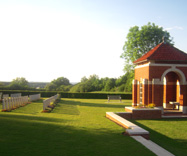
The British
Commonwealth Cemetery is just south of the village of
Hotton, take the road just past the tank turret. The German
Military Cemetery is at Recogne, just outside Bastogne near
the fateful village of Foy (Soldaten
Graves Recogne).
American
Military Cemeteries are located in the northern and southern ends
of the area. The Henri-Chapelle Cemetery in the tiny
village of Hombourg near Liege is one of the largest of American Military
cemeteries in Europe,
with nearly 8,000 soldier and airmen graves from the fighting in the
Ardennes and northern Germany. The cemetery at Neuville-en-Condroz to
the southwest of Liege has 5,000 more war dead, many from the capture
of Aachen before the Ardennes battles. The American Cemetery
in Luxembourg,
just a mile from the Luxembourg Airport in the tiny country between Belgium,
France and Germany holds another 5,000.
It is at Luxembourg where General George Patton rests, still facing his
troops (see General
Patton Luxembourg).
The British
Commonwealth Cemetery is just south of the village of
Hotton, take the road just past the tank turret. The German
Military Cemetery is at Recogne, just outside Bastogne near
the fateful village of Foy (Soldaten
Graves Recogne).
Malmedy and Baugnez Massacre Memorial
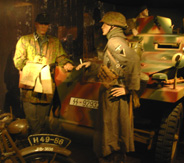 Between
them a trail of museums, monuments and battleground sites can be easily
visited. A new
museum commemorating
the battles has opened
at the site of the American massacre at Baugnez, just outside of the
heavily shelled town of Malmedy. On December 17, 1944 an American convoy
was caught by Lt. Colonel Pieper’s Kampfgruppe at a crossroads.
After a brief fight, most of the Americans were taken prisoner. The
impatient
panzer leader Pieper moved on, but German units that followed shot the
captured Americans in a meadow. A memorial now stands at the crossroads
and the Baugnez ’44 Historical Museum is nearby
at the edge of the meadow. The museum is two floors of artifacts,
with a recorded
history of the battle of the bulge events. There is a café next
door. The town of Malmedy was heavily fought over, but now is a peaceful
Belgium vacation town, with a plaza of outdoor cafes, popular with motorcyclists
and tour groups. Baugnez
44 Historical Center
Between
them a trail of museums, monuments and battleground sites can be easily
visited. A new
museum commemorating
the battles has opened
at the site of the American massacre at Baugnez, just outside of the
heavily shelled town of Malmedy. On December 17, 1944 an American convoy
was caught by Lt. Colonel Pieper’s Kampfgruppe at a crossroads.
After a brief fight, most of the Americans were taken prisoner. The
impatient
panzer leader Pieper moved on, but German units that followed shot the
captured Americans in a meadow. A memorial now stands at the crossroads
and the Baugnez ’44 Historical Museum is nearby
at the edge of the meadow. The museum is two floors of artifacts,
with a recorded
history of the battle of the bulge events. There is a café next
door. The town of Malmedy was heavily fought over, but now is a peaceful
Belgium vacation town, with a plaza of outdoor cafes, popular with motorcyclists
and tour groups. Baugnez
44 Historical Center
Sankt Vith, Vielsalm and Poteau Battlefield Museum
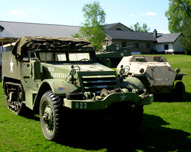 Sankt
Vith and Vielsalm were crucial battle points, heavily bombed, defended,
taken and recaptured.
Between
them, at a crossroads of Poteau,
German divisions of the 1st and 9th SS Panzers met units of the American
US 14th Cavalry. The crossroads was nicknamed “Dante’s Inferno” ultimately
taken by the advancing Germans and featured in German propaganda film
footage. At the Poteau 44 Museum, located in a former
customs building turned into a museum, German fighting film footage
can be watched, then
take a tour of the actual battle site in the film in a rebuilt American
or German Half-Track. The museum features weapons, uniforms, documents
and realistic dioramas of American and German units. This museum is the
one in the area most focused on vehicles, many of them restored to running
condition. Poteau
'44 Museum
Sankt
Vith and Vielsalm were crucial battle points, heavily bombed, defended,
taken and recaptured.
Between
them, at a crossroads of Poteau,
German divisions of the 1st and 9th SS Panzers met units of the American
US 14th Cavalry. The crossroads was nicknamed “Dante’s Inferno” ultimately
taken by the advancing Germans and featured in German propaganda film
footage. At the Poteau 44 Museum, located in a former
customs building turned into a museum, German fighting film footage
can be watched, then
take a tour of the actual battle site in the film in a rebuilt American
or German Half-Track. The museum features weapons, uniforms, documents
and realistic dioramas of American and German units. This museum is the
one in the area most focused on vehicles, many of them restored to running
condition. Poteau
'44 Museum
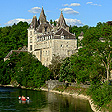
La Roche-En-Ardenne - Battle of Ardennes Museum
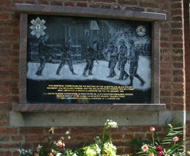 Located
in a steep mountain valley, watched over by the ruins of an ancient
medieval fortress, La Roche-en-Ardenne
(see Castle La
Roche) was liberated
in January of 1945
by units of the 1st Battalion of Scottish Black Watch and Northhamptonshire
Yeomen Regiment, who met up with American units at a street corner in
the small town. A half block from the corner is the Battle of the Ardennes
Museum with a collection of weapons, uniforms and artifacts.
The Battle
of the Ardennes Museum is the only museum in
the area with a full British section, also featuring one of the few
remaining “Enigma” decoding
machines and a memorial room with gifts and memorabilia of veterans who
have returned to visit. La Roche-en-Ardennes was a very popular tourist
resort town in Belgium before the war and remains one today.
Located
in a steep mountain valley, watched over by the ruins of an ancient
medieval fortress, La Roche-en-Ardenne
(see Castle La
Roche) was liberated
in January of 1945
by units of the 1st Battalion of Scottish Black Watch and Northhamptonshire
Yeomen Regiment, who met up with American units at a street corner in
the small town. A half block from the corner is the Battle of the Ardennes
Museum with a collection of weapons, uniforms and artifacts.
The Battle
of the Ardennes Museum is the only museum in
the area with a full British section, also featuring one of the few
remaining “Enigma” decoding
machines and a memorial room with gifts and memorabilia of veterans who
have returned to visit. La Roche-en-Ardennes was a very popular tourist
resort town in Belgium before the war and remains one today.
ACES: A Novel of WWII Pilots in the Battle of Britain
Bastogne - Historical Center Memorial
 Perhaps
best known from the "Battle of the Bulge", due to the one
word response to a German demand
to surrender,
Bastogne has the most monuments
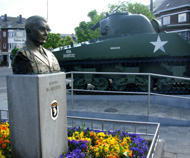
to the war in area. The town square is dominated by a Sherman
tank next to a bust statue of General Anthony McAuliffe whose invective “Nuts” is
probably the best known and most decisive one-word communication in military
history. The town square is now named for General McAuliffe.
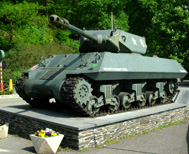
The roads leading into Bastogne are marked with tank turrets marking
the
town's
defensive perimeter, along with red, white and blue concrete markers
of the Voie de Liberte (Liberty Way). A few kilometers
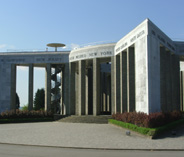
outside Bastogne is the massive Battle of Ardennes Memorial monument
of Madasson, erected by the people of Belgium
to honor the liberation of their country by the American defenders. The
monument names all 50 states, even though only 48 were official at the
time of the war. A wide view of the area can be had climbing to the roof.
Next to the monument is the newly refurbished Bastogne Historical Center.
Perhaps
best known from the "Battle of the Bulge", due to the one
word response to a German demand
to surrender,
Bastogne has the most monuments
to the war in area. The town square is dominated by a Sherman
tank next to a bust statue of General Anthony McAuliffe whose invective “Nuts” is
probably the best known and most decisive one-word communication in military
history. The town square is now named for General McAuliffe.
The roads leading into Bastogne are marked with tank turrets marking
the
town's
defensive perimeter, along with red, white and blue concrete markers
of the Voie de Liberte (Liberty Way). A few kilometers
outside Bastogne is the massive Battle of Ardennes Memorial monument
of Madasson, erected by the people of Belgium
to honor the liberation of their country by the American defenders. The
monument names all 50 states, even though only 48 were official at the
time of the war. A wide view of the area can be had climbing to the roof.
Next to the monument is the newly refurbished Bastogne Historical Center.
101st Airborne ECompany - Band of Brothers
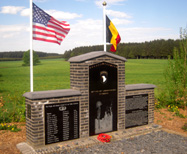 Probably
the most affecting site you can visit in the Bastogne area is a few
kilometers from the
official
monument and historic center, you
come to a small recent monument to the men of E-Company of the 101st,
whose exploits were made most familiar through the HBO television series “Band
of Brothers”. Anyone familiar with the program will recognize names
on the marker. But a few hundred yards away, you can walk into the thick
Ardennes forest trees to find the very fox holes from which E-Company
faced the German advance from the tiny village of Foy (see Bastogne
101st Foxholes). They remain much
as they were, slowing filling in with dirt and debris over the years.
The trees destroyed by German armored shelling have been cut to stumps.
It’s possible to find this site on your own, but it is unmarked
and may be best to get a tour guide through the visitors center in downtown
Bastogne. On the other side of the village of Foy is Recogne where nearly
7,000 German soldiers are buried in Belgian soil, reminding one that
war is never one-sided.
Probably
the most affecting site you can visit in the Bastogne area is a few
kilometers from the
official
monument and historic center, you
come to a small recent monument to the men of E-Company of the 101st,
whose exploits were made most familiar through the HBO television series “Band
of Brothers”. Anyone familiar with the program will recognize names
on the marker. But a few hundred yards away, you can walk into the thick
Ardennes forest trees to find the very fox holes from which E-Company
faced the German advance from the tiny village of Foy (see Bastogne
101st Foxholes). They remain much
as they were, slowing filling in with dirt and debris over the years.
The trees destroyed by German armored shelling have been cut to stumps.
It’s possible to find this site on your own, but it is unmarked
and may be best to get a tour guide through the visitors center in downtown
Bastogne. On the other side of the village of Foy is Recogne where nearly
7,000 German soldiers are buried in Belgian soil, reminding one that
war is never one-sided.
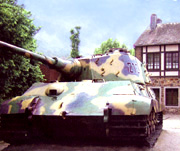 A
monument to the “Big
Red One” 1st Infantry Division can
be found in the village of Eupen. A 69-ton German Royal Tiger Tank abandoned
by Lt. Colonel Peiper remains at a crossroad at La Glieze. The December ’44
Museum at La Glieze offers dioramas, photographs and maps of
the German tank advance stopped at there. Other towns like Baraque-La-Frature,
Manhay,
Rochefort, Dinant and Celles have monuments marked by plaques or remaining
pieces of armor or artillery. December
44
A
monument to the “Big
Red One” 1st Infantry Division can
be found in the village of Eupen. A 69-ton German Royal Tiger Tank abandoned
by Lt. Colonel Peiper remains at a crossroad at La Glieze. The December ’44
Museum at La Glieze offers dioramas, photographs and maps of
the German tank advance stopped at there. Other towns like Baraque-La-Frature,
Manhay,
Rochefort, Dinant and Celles have monuments marked by plaques or remaining
pieces of armor or artillery. December
44
A map of all the Battle of the Bulge sites and a brochure “The Battle of the Ardennes: Down Memory Lane” can be obtained at many of the museums in the area or can be gotten by contacting the Belgium Tourism offices for the region of Wallonia or download a pdf here. © Bargain Travel Europe
Find best hotel and travel deals in The Ardennes
Web Info
Belgium
Tourism
These articles are copyrighted and the sole property of Bargain Travel Europe and WLPV, LLC. and may not be copied or reprinted without permission.
SEE ALSO:
FLANDERS
FIELDS WWI MUSEUMS AND MONUMENTS
AMERICAN MILITARY CEMETARIES IN FRANCE
WWI
BATTLEFIELDS OF THE SOMME
EUROSTAR
LONDON / PARIS
ORVAL
ABBEY MONASTERY BELGIAN
BEER
BOUILLON
CRUSADER CASTLE ON THE SEMOIS RIVER

