


WHITBY ABBEY - NORTH YORKSHIRE COAST
Dracula, Captain Cook, The Moors and Gothic Golf
 Foggy
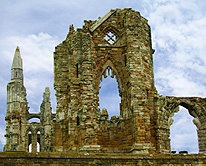
mists drifting off the ocean coast cliff, fingers of moisture caressing
ancient headstones of the graveyard
under the shadow of the
jutting jagged stone of an abandoned and wrecked abbey. An abandoned
ship crashes into the docks of the English sea town, its dead captain
lashed to the wheel as a giant dog leapt ashore. It was partly his view
of the Abbey at Whitby on the eastern English coast of North Yorkshire,
that inspired former theater manager Bram Stoker to write gothic literature’s
most enduring novel and one of its most famous characters, Dracula. He
could see the view of the ghostly ruin on the East Cliff of Whitby above
the harbor and small narrow streets next to the moody
graveyard of St Marys Church from the window of the hotel where he wrote
much of his
most well known gothic novel after researching and commencing in his homeland
of Ireland (see Marsh's
Library Dublin).
Foggy
mists drifting off the ocean coast cliff, fingers of moisture caressing
ancient headstones of the graveyard
under the shadow of the
jutting jagged stone of an abandoned and wrecked abbey. An abandoned
ship crashes into the docks of the English sea town, its dead captain
lashed to the wheel as a giant dog leapt ashore. It was partly his view
of the Abbey at Whitby on the eastern English coast of North Yorkshire,
that inspired former theater manager Bram Stoker to write gothic literature’s
most enduring novel and one of its most famous characters, Dracula. He
could see the view of the ghostly ruin on the East Cliff of Whitby above
the harbor and small narrow streets next to the moody
graveyard of St Marys Church from the window of the hotel where he wrote
much of his
most well known gothic novel after researching and commencing in his homeland
of Ireland (see Marsh's
Library Dublin).
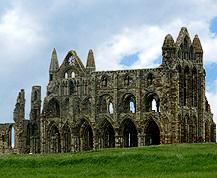 The abbey
was first established by the King of Northumberland in the Saxon days
of the 7th Century. It
was
featured
in the setting of the
date of Easter to the Roman calendar rather than the Celtic calendar
at the Synod of Whitby. Sometimes known as St. Hilda’s Abbey
after it first abbess, the current form of the ruin is a gothic era
structure,
destroyed when Henry VIII dissolved the monasteries of the Catholic
Church in England.
The abbey
was first established by the King of Northumberland in the Saxon days
of the 7th Century. It
was
featured
in the setting of the
date of Easter to the Roman calendar rather than the Celtic calendar
at the Synod of Whitby. Sometimes known as St. Hilda’s Abbey
after it first abbess, the current form of the ruin is a gothic era
structure,
destroyed when Henry VIII dissolved the monasteries of the Catholic
Church in England.
 Whitby
was a quiet little sea village at the mouth of the Esk River, sandwiched
between the North
Sea coast and the desolate scrabby moors
of North Yorkshire, now the North Yorkshire Moors National Park.
Whitby became an important sea port with the coming of mining and
was a major
center of whaling, ultimately discovered as a seaside resort in
the late 1800s, now busy in the travel season with a number of bed & breakfasts
and small hotels catering to travelers visiting the park and coastal
area between York and Newcastle. If you look carefully, you might
spot the resort towns most famous literary citizen bloodsucker on
holiday.
Whitby
was a quiet little sea village at the mouth of the Esk River, sandwiched
between the North
Sea coast and the desolate scrabby moors
of North Yorkshire, now the North Yorkshire Moors National Park.
Whitby became an important sea port with the coming of mining and
was a major
center of whaling, ultimately discovered as a seaside resort in
the late 1800s, now busy in the travel season with a number of bed & breakfasts
and small hotels catering to travelers visiting the park and coastal
area between York and Newcastle. If you look carefully, you might
spot the resort towns most famous literary citizen bloodsucker on
holiday.
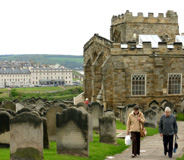 Reaching
Whitby Abbey from town by foot it is necessary to climb a staircase
of exactly 199 steps that have been in place for nearly a
hundred years
and recently repaired. The town’s most famous
site can also be reached by car up a winding road from the harbor and
a pay
parking
lot. Two on-off open top tour bus services run in Whitby traveling
around the village to most of the touring sites and cost £4.
Traffic on the main coast
road through town can get quite busy.
Reaching
Whitby Abbey from town by foot it is necessary to climb a staircase
of exactly 199 steps that have been in place for nearly a
hundred years
and recently repaired. The town’s most famous
site can also be reached by car up a winding road from the harbor and
a pay
parking
lot. Two on-off open top tour bus services run in Whitby traveling
around the village to most of the touring sites and cost £4.
Traffic on the main coast
road through town can get quite busy.
The nautical heritage of Whitby is famously tied to scientific
explorer Captain James Cook who set sail from the harbor of Whitby
in the
HMS Endeavor. Cook was not born in Whitby, but studied seamanship
here.
The Captain James Cook Memorial
Museum is located in the 17th Century
house
of Quaker ship owner John Walker, for Cook apprenticed. The museum
displays letters, ship models, maps and paintings associated with
Cook and his
other ship Resolution. Also on display, loaned from the British
Museums collections are examples of the botanical studies of botanist
Joseph
Banks, sometimes called the “Great South Sea Caterpillar” for
his slow studies of south Pacific island plants.
Moored at the harbor at Whitby is a replica of the HMS Endeavor
which offers harbor and sea coast cruises, following the path and
story
of Cook, with views of the Yorkshire Coast, in
season viewing porpoises, seals and sea birds, while listening
to sea shanties
sung
by the crew.
Whitby’s connection to gothic literature and Bram Stoker’s
Dracula has made it a sort of Mecca for the lovers of things gothic,
celebrated twice each year at the Whitby
Gothic Weekend, held
at the town’s
Spa Pavilion usually in April and October (Halloween). Goth enthusiasts
come from all over England and around the world to fill the small
village for
the spring and fall equinox with jolly party folks in black.
 For
those with a bent for unusual spots for play golf, the charming
public Whitby Golf Club is
located about a mile north of the village with greens set on the
sea cliffs,
providing magnificent views and challenging head
winds trying to drive across the striking deep ravine cutting through
the 6th and 18th holes.
For
those with a bent for unusual spots for play golf, the charming
public Whitby Golf Club is
located about a mile north of the village with greens set on the
sea cliffs,
providing magnificent views and challenging head
winds trying to drive across the striking deep ravine cutting through
the 6th and 18th holes.
For steam rail enthusiasts, Whitby is at the coast end of the North
Yorkshire Moors Steam Railway, though the schedule to Whitby is
limited and more
commonly departing from Pickering (see North
Yorkshire Moors Steam Rides).
Whitby is about a hour and half from York by car on the coast road.
By rail, Whitby is reached through connections from Middlesborough
and
Darlington. From the south, its easier to take a bus from Scarborough,
York or Leeds where
Whitby
is
served
by the Yorkshire
Coastliner Bus. Also along this route are Pickering
for the steam train and the impressive Castle Howard used as the
location for the film "Brideshead Revisited" (see Castle
Howard Revisited). © Bargain
Travel Europe
Find the best travel deals in Whitby-North
Yorkshire
Holiday cottage in Whitby at Dales
Holiday Cottages
Web Info
Yorkshire
Moors Coast Tourism
These articles are copyrighted and the sole property of Bargain Travel Europe and WLPV, LLC. and may not be copied or reprinted without permission.
See Also:
THE
SALTBURN SMUGGLERS
RUSHPOOL
HALL HOTEL

