

MARSH’S
LIBRARY - DUBLIN
Three Centuries of Literary Research
 Dublin has been
named by UNESCO as the City of Literature for 2011. Famed for its
numerous noted writers of the canon of English letters,
Jonathan Swift, James Joyce, George Bernard Shaw, Oscar Wilde, Sean
O’Casey, and Bram Stoker, among a roster of others. Literary
pub crawls wander the city in the dusk of evening, discovering the
tippling spots of liquid inspiration. But much of the responsibility
for Dublin’s literary heritage can be placed at the doorstep
of a bachelor clergyman, the Archbishop Narcissus Marsh.
Dublin has been
named by UNESCO as the City of Literature for 2011. Famed for its
numerous noted writers of the canon of English letters,
Jonathan Swift, James Joyce, George Bernard Shaw, Oscar Wilde, Sean
O’Casey, and Bram Stoker, among a roster of others. Literary
pub crawls wander the city in the dusk of evening, discovering the
tippling spots of liquid inspiration. But much of the responsibility
for Dublin’s literary heritage can be placed at the doorstep
of a bachelor clergyman, the Archbishop Narcissus Marsh.
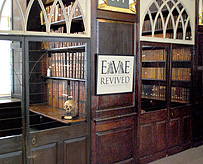
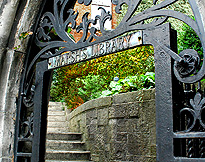 Marsh’s Library behind a Gothic arched iron gate on St Patrick’s
Close, just around the corner from the great cathedral, founded in
1701 and celebrating its 310th birthday, was the first public library
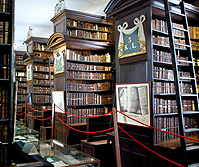
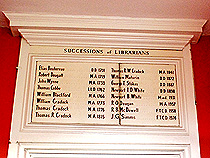
in Dublin. The library’s interior, beyond the doorway listing
the succession of librarians, with its beautiful rows of tall dark
oaken bookcases, remains virtually unchanged since it was built three
centuries ago, remaining an extraordinary example of a 17th century
scholars' library.
Marsh’s Library behind a Gothic arched iron gate on St Patrick’s
Close, just around the corner from the great cathedral, founded in
1701 and celebrating its 310th birthday, was the first public library
in Dublin. The library’s interior, beyond the doorway listing
the succession of librarians, with its beautiful rows of tall dark
oaken bookcases, remains virtually unchanged since it was built three
centuries ago, remaining an extraordinary example of a 17th century
scholars' library.
 The
idea for a public library came to Marsh while he was provost at Trinity
College, seeing how difficult it was to gain
access to use the library there (see Trinity Old Library
and Book of Kells). Marsh provided his own personal collection of books
and purchased
the 10,000 volume collection of Edward Stillingfleet, the Bishop
of Worcester for £2,500 in 1705. The library’s first administrator
Dr. Elias Bouhéreau, a French Hugenot, also added his own books
of religious controversies and the study of Calvanism in France to
the collection. The library now houses over 25,000 books of the 16th
to 18th centuries, covering the broad fields of medicine, science,
law, mathematics, travel & navigation, music, surveying and
classical literature.
The
idea for a public library came to Marsh while he was provost at Trinity
College, seeing how difficult it was to gain
access to use the library there (see Trinity Old Library
and Book of Kells). Marsh provided his own personal collection of books
and purchased
the 10,000 volume collection of Edward Stillingfleet, the Bishop
of Worcester for £2,500 in 1705. The library’s first administrator
Dr. Elias Bouhéreau, a French Hugenot, also added his own books
of religious controversies and the study of Calvanism in France to
the collection. The library now houses over 25,000 books of the 16th
to 18th centuries, covering the broad fields of medicine, science,
law, mathematics, travel & navigation, music, surveying and
classical literature.
 Public
access to a great library allowed many of the future literary lights
of Dublin
to spend hours among its treasures, locked in the
cages where the rare works would be delivered, with entrance and perusal
based on a signiture. The hand scrawls of the likes of Jonathan Swift,
Bram Stoker and James Joyce can be found in the ledger. Bram Stoker
began writing his first drafts of Dracula among the high stacked shelves
of Marsh’s Library (see Whitby
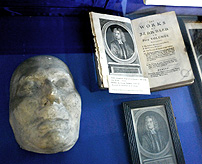
Abbey). Jonathan Swift, the author
of Gulliver’s
Travels, still remains at the library, in spirit at least, the Swift
Case displays printed works of the satirical fantasist and his plaster
death mask.
Public
access to a great library allowed many of the future literary lights
of Dublin
to spend hours among its treasures, locked in the
cages where the rare works would be delivered, with entrance and perusal
based on a signiture. The hand scrawls of the likes of Jonathan Swift,
Bram Stoker and James Joyce can be found in the ledger. Bram Stoker
began writing his first drafts of Dracula among the high stacked shelves
of Marsh’s Library (see Whitby
Abbey). Jonathan Swift, the author
of Gulliver’s
Travels, still remains at the library, in spirit at least, the Swift
Case displays printed works of the satirical fantasist and his plaster
death mask.
 There are four main
collections in Marsh’s Library, of 80 books
printed before 1501 called the Incunabula, books from Italy before
1600, 1,200 books printed in England before 1640 and 5,000 tomes printed
in England before 1700. There is a large amount of liturgical and theology
works, books of hours and historic bibles printed in almost every language.
A separate room is reserved for books and periodicals covering Irish
history over the last hundred years.
There are four main
collections in Marsh’s Library, of 80 books
printed before 1501 called the Incunabula, books from Italy before
1600, 1,200 books printed in England before 1640 and 5,000 tomes printed
in England before 1700. There is a large amount of liturgical and theology
works, books of hours and historic bibles printed in almost every language.
A separate room is reserved for books and periodicals covering Irish
history over the last hundred years.
Exhibitions at Marsh’s Library change from time to time, currently on display are medical works in a theme called 'Hippocrates Revived', featuring early books on medicine, or what passed for it, elaborately illustrated with woodcuts and engravings. The exhibition includes the ancient Greek medical theories of Hippocrates and Galen, an account of the first human blood transfusion in 1887 by by Jean Baptiste Denis, physician to Louis XIV, and the controverial book by Johannes Wier which caused an uproar in 1563 by having the temarity to suggest that the confessions of witches were delusions.
Visiting Marsh’s Library
The library’s public normal opening hours are Monday and Wednesday to Friday, 9.30am to 1pm and 2pm to 5pm; and Saturday 10am to 1pm. It is closed on Tuesday and Sunday. Admission to the library is €3 for adults, €2 for students and seniors and children are free. The founder of the library Narcissus Marsh is buried next door in the graveyard of St Patrick’s Cathedral. And for the literary pub crawlers, there is no bar at the library. © Bargain Travel Europe
Find best hotel and travel deals in Dublin on TripAdvisor
Web
Info
Marsh Library
These articles are copyrighted and the sole property of Bargain Travel Europe and WLPV, LLC. and may not be copied or reprinted without permission.
SEE ALSO:
ARMAGH PUBLIC LIBRARY & VICAR’S HILL No 5

