

SWISS
MUSEUM OF TRANSPORT LUCERNE
Top Family Attraction and Transporation History
 It
is Switzerland’s
most popular museum attracting almost a million visitors per year.
The Swiss Transport Museum on the shimmering shores
of Lake Lucerne celebrated its 50th birthday in 2009 and
with the opening of a new 50 million Swiss Franc upgrade. Sure, it has
exhibits of trains, planes and automobiles – ships, too, but
what makes the Museum of Transport (Verkehrshaus
Luzern) stand out is its total fascination
for kids. Adults can check
out the history of steam and electric train locomotives which
powered Switzerland’s unique rail system – discover the secrets
behind
It
is Switzerland’s
most popular museum attracting almost a million visitors per year.
The Swiss Transport Museum on the shimmering shores
of Lake Lucerne celebrated its 50th birthday in 2009 and
with the opening of a new 50 million Swiss Franc upgrade. Sure, it has
exhibits of trains, planes and automobiles – ships, too, but
what makes the Museum of Transport (Verkehrshaus
Luzern) stand out is its total fascination
for kids. Adults can check
out the history of steam and electric train locomotives which
powered Switzerland’s unique rail system – discover the secrets
behind 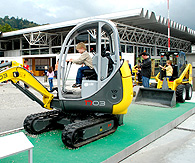 digging tunnels through the great mountains of the Alps - follow
the
history of flight from balloons to gliders to mountain rescue helicopters
and the passenger jets of Swiss Airlines – but kids are the focus
of the interactive exhibits at the Museum of Transport, with all sorts
of things to do, touch and imagine. The
museum's 3,000 exhibits are laid out in 20,000 meters of exhibit halls
around
a central
open plaza. The entrance is uniquely identifiable
by its wall of car wheels lining the outside of the new FutureCom
entrance which houses the ticket counters, a restaurant, the Imax Theater,
and upstairs the new Media Factory.
digging tunnels through the great mountains of the Alps - follow
the
history of flight from balloons to gliders to mountain rescue helicopters
and the passenger jets of Swiss Airlines – but kids are the focus
of the interactive exhibits at the Museum of Transport, with all sorts
of things to do, touch and imagine. The
museum's 3,000 exhibits are laid out in 20,000 meters of exhibit halls
around
a central
open plaza. The entrance is uniquely identifiable
by its wall of car wheels lining the outside of the new FutureCom
entrance which houses the ticket counters, a restaurant, the Imax Theater,
and upstairs the new Media Factory.
 The
first hall houses the rail museum, starting with a model railroad of
the
Swiss mountains and
rail track through the passes. The Gotthard Tunnel Show and hands
on interactive exhibits demonstrate the mastery of the mountains
through digging tunnels and hands-on displays demonstrate modern
kinetic energy recovery for powering trains of
the future.
The
first hall houses the rail museum, starting with a model railroad of
the
Swiss mountains and
rail track through the passes. The Gotthard Tunnel Show and hands
on interactive exhibits demonstrate the mastery of the mountains
through digging tunnels and hands-on displays demonstrate modern
kinetic energy recovery for powering trains of
the future. 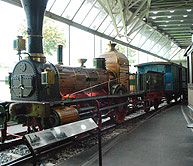 In
the main hall find the landmarks of Swiss mechanical engineering,
from the “Crocodile” mountain
freight engine, cutaways of steam boilers and the first electric
street cars, to the cogwheels of the Jungfraubahn (see Jungfraujoch
Railway through the Eiger) and the Mt Rigi Steam cog
train (see Mt
Rigi Bahn).
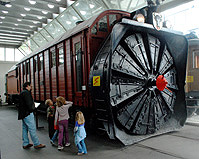
A snow
blower
engine
from the Gotthardbahn can be found in the display hall below, or
walk underneath a giant steam locomotive, the “Elephant”,
Switzerland's last great steam behemoth.
In
the main hall find the landmarks of Swiss mechanical engineering,
from the “Crocodile” mountain
freight engine, cutaways of steam boilers and the first electric
street cars, to the cogwheels of the Jungfraubahn (see Jungfraujoch
Railway through the Eiger) and the Mt Rigi Steam cog
train (see Mt
Rigi Bahn).
A snow
blower
engine
from the Gotthardbahn can be found in the display hall below, or
walk underneath a giant steam locomotive, the “Elephant”,
Switzerland's last great steam behemoth.
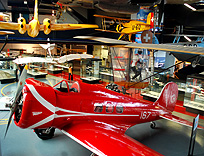 Across
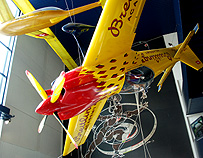
the courtyard underneath the mounted jet airplane, the flight hall
provides three levels aircraft from early flight to outer space.
Vintage airplanes on the floor and suspended from above, aircraft
models and a very popular flight simulator ride. The Cosmorama, a
form of
hand operated merry-go-round demonstrates gravity and weightlessness.
Aircraft
on display include the Cross Channel Blériot XI-b and the
red Lockheed Orion 9C the “Roter Hund” Red Hound, the
fastest commercial plane of the 30s, race planes in dramatic maneuvers
and
the workhorse DC3. The Marine exhibit hall displays shipping with
a cutaway
section of paddlewheel steamer, like those which ply the waters of
Lake Lucerne, a full scale sailing schooner and ferry that can be
deck-walked
and climbed upon.
Across
the courtyard underneath the mounted jet airplane, the flight hall
provides three levels aircraft from early flight to outer space.
Vintage airplanes on the floor and suspended from above, aircraft
models and a very popular flight simulator ride. The Cosmorama, a
form of
hand operated merry-go-round demonstrates gravity and weightlessness.
Aircraft
on display include the Cross Channel Blériot XI-b and the
red Lockheed Orion 9C the “Roter Hund” Red Hound, the
fastest commercial plane of the 30s, race planes in dramatic maneuvers
and
the workhorse DC3. The Marine exhibit hall displays shipping with
a cutaway
section of paddlewheel steamer, like those which ply the waters of
Lake Lucerne, a full scale sailing schooner and ferry that can be
deck-walked
and climbed upon.
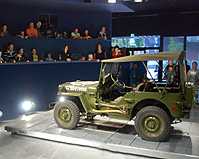 The
newly redesigned auto hall, distinctively covered with road signs
on the outside and on the inside, is one of the more unique car exhibits
you’ll find. Most auto museum have historic vehicles on static
floor display with some descriptive text, some quite dynamic (see Mercedes
Benz Museum Stuttgart), but the Swiss Transport Museum
does it a little differently.
The
newly redesigned auto hall, distinctively covered with road signs
on the outside and on the inside, is one of the more unique car exhibits
you’ll find. Most auto museum have historic vehicles on static
floor display with some descriptive text, some quite dynamic (see Mercedes
Benz Museum Stuttgart), but the Swiss Transport Museum
does it a little differently. 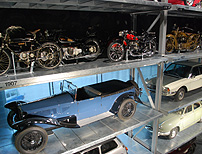 Rather
like a game show, the historic cars in the Car Theater are set on
racks with visitors in bleachers.
The audience slaps knobs to vote together in a frantic competition.
The most voted car is
selected by a moving hydraulic lift and brought to the show floor
where its
history is demonstrated. The narration is in German, but who cares,
its cars
on demand fun. There is also a car crash test and Formula 1 driving
exhibit to entertain along with a variety of interactive exhibits
of car design
and road technology.
Rather
like a game show, the historic cars in the Car Theater are set on
racks with visitors in bleachers.
The audience slaps knobs to vote together in a frantic competition.
The most voted car is
selected by a moving hydraulic lift and brought to the show floor
where its
history is demonstrated. The narration is in German, but who cares,
its cars
on demand fun. There is also a car crash test and Formula 1 driving
exhibit to entertain along with a variety of interactive exhibits
of car design
and road technology.
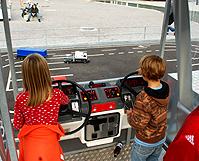 Outside
in the central courtyard called "The Arena" is probably the busiest.
Not exactly a museum, but perhaps more a learning and play area, where
kids can operate child size excavators and construction equipment
to
build their own roads, flip and fly on a gravity defying bungee trampoline,
drive pedal cars around a road track, learn road signs and traffic
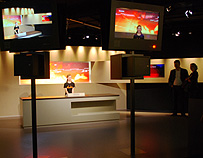
rules, skipper model power boats or test ride mountain bikes. Before
departing make the last stop at the new Media Factory where budding
young
tv personalities can appear in their own their own tv and radio programs
in the studios, from greenscreen effects to news announcing, or journey
to the stars in the Planetarium. From
spring to fall a special exhibition - the "Talent Show" exhibition
features a host of interactive highlights such as talent platforms, prompters
and
talent meetings offering a
chance to discover your talents and experience the
diversity of professions in the world of mobility and transport.
Outside
in the central courtyard called "The Arena" is probably the busiest.
Not exactly a museum, but perhaps more a learning and play area, where
kids can operate child size excavators and construction equipment
to
build their own roads, flip and fly on a gravity defying bungee trampoline,
drive pedal cars around a road track, learn road signs and traffic
rules, skipper model power boats or test ride mountain bikes. Before
departing make the last stop at the new Media Factory where budding
young
tv personalities can appear in their own their own tv and radio programs
in the studios, from greenscreen effects to news announcing, or journey
to the stars in the Planetarium. From
spring to fall a special exhibition - the "Talent Show" exhibition
features a host of interactive highlights such as talent platforms, prompters
and
talent meetings offering a
chance to discover your talents and experience the
diversity of professions in the world of mobility and transport.
 The
Swiss Museum of Transport is not exactly cheap. Admission prices are
more on the amusement
park level than museum, but worth it. Adults
single admission is 27 CHF, children 12 CHF (under 6 free) with a family
pass for 56 CHF (50% discount with a Swiss Pass). The Imax Theater is
a separate admission with a combined ticket available. Getting to the
Transport Museum is as easy as Lucerne’s transport system. From
the Lucerne main train station take the S3 train or the Voralpexpress
to the Verkehrshaus station, or city bus 6, 8, or 24. By car the museum
is to the east of town center on the north side of the lake shore, follow
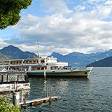
the signs. The Transport Museum and Imax can also be reached by lake
boat (March-October), the first stop for Lake Lucerne cruise boats from
the terminal pier (see Lake
Lucerne Cruise Boats). Come by train and return by boat with a Lucerne
transportation card or a Swiss Pass. Or the walk along the lakeshore
is about 30 minutes
from the Lucerne Bridge. © Bargain
Travel Europe
The
Swiss Museum of Transport is not exactly cheap. Admission prices are
more on the amusement
park level than museum, but worth it. Adults
single admission is 27 CHF, children 12 CHF (under 6 free) with a family
pass for 56 CHF (50% discount with a Swiss Pass). The Imax Theater is
a separate admission with a combined ticket available. Getting to the
Transport Museum is as easy as Lucerne’s transport system. From
the Lucerne main train station take the S3 train or the Voralpexpress
to the Verkehrshaus station, or city bus 6, 8, or 24. By car the museum
is to the east of town center on the north side of the lake shore, follow
the signs. The Transport Museum and Imax can also be reached by lake
boat (March-October), the first stop for Lake Lucerne cruise boats from
the terminal pier (see Lake
Lucerne Cruise Boats). Come by train and return by boat with a Lucerne
transportation card or a Swiss Pass. Or the walk along the lakeshore
is about 30 minutes
from the Lucerne Bridge. © Bargain
Travel Europe
Find best hotel and travel deals for Lucerne on TripAdvisor
Web Info
Lucerne
Verkehrshaus
These articles are copyrighted and the sole property of Bargain Travel Europe and WLPV, LLC. and may not be copied or reprinted without permission.
SEE ALSO:
GOLDENPASS SCENIC TRAIN - LUCERNE-MONTREUX
MOUNT PILATUS RAILWAY AND AERIAL CABLE
MT. TITLUS ROTAIR - ROTATING AERIAL CABLE
POHO
WEGGIS - DESIGN HOTEL ON LAKE LUCRENE

