
MAILATH CASTLE OF DONJI MIHOLJAC
English Tudor Mansion in Slavonia, Croatia
 After the Austro-Hungarian Emperor Franz Joseph came to call on the counts
of Prandau, the aristocratic family was rather embarrassed that their old
Baroque era castle from 1818, once a local prize with the first tile roof
in the region, didn’t quite come up to Imperial standards. It didn’t
have enough bedrooms to host the Emperor’s party. Count Ladislav
Mailath promised the Emperor if he returned there would be a castle of
appropriate size to host the next visit.
After the Austro-Hungarian Emperor Franz Joseph came to call on the counts
of Prandau, the aristocratic family was rather embarrassed that their old
Baroque era castle from 1818, once a local prize with the first tile roof
in the region, didn’t quite come up to Imperial standards. It didn’t
have enough bedrooms to host the Emperor’s party. Count Ladislav
Mailath promised the Emperor if he returned there would be a castle of
appropriate size to host the next visit. 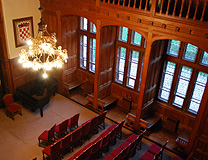 Construction of the new castle
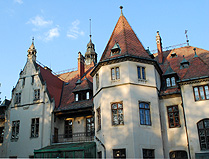
was begun in 1903. Fascinated with the Tudor royal houses of England’s
aristocracy, popular with Victorian neo-romanticist revival, the Mailath
manor house was designed by Budapest architect Istvan Moller in gothic
influenced English Tudor style, with 50 rooms of rich wood
paneling throughout, featuring numerous chimney towers, some where there
were no
fireplaces,
mansard style
windows, and intricate patterned tile roof.
Construction of the new castle
was begun in 1903. Fascinated with the Tudor royal houses of England’s
aristocracy, popular with Victorian neo-romanticist revival, the Mailath
manor house was designed by Budapest architect Istvan Moller in gothic
influenced English Tudor style, with 50 rooms of rich wood
paneling throughout, featuring numerous chimney towers, some where there
were no
fireplaces,
mansard style
windows, and intricate patterned tile roof.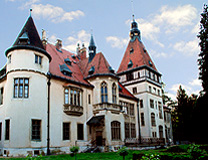 The Malaith Castle, the last of its kind to be built by
the Slavonian aristocracy was set in an expansive green park with fountain
pond and glasshouse
for tropical plants. There was once a bowling alley in a garden pavilion,
but now gone. The count spent a lot of time away from his castle, sending
home trophies from his hunting trips to Africa and Asia, filling the walls
with animal heads and other collections. The Austrian Arch Duke Franz Ferdinand
a close friend, liked to come to hunt , with his last visit just
three months before his assassination in Sarajevo in 1914 (see Habsburg
Crypt Vienna). World War I and the worldwide depression following the
market crash of
1929 brought
hard times on the Prandau counts. The house was sold in 1930 to the Jewish
Schlesinger family, who only enjoyed the mansion for ten years before the
commencement of World War II, escaping in advance of the Nazis occupation.
The Malaith Castle, the last of its kind to be built by
the Slavonian aristocracy was set in an expansive green park with fountain
pond and glasshouse
for tropical plants. There was once a bowling alley in a garden pavilion,
but now gone. The count spent a lot of time away from his castle, sending
home trophies from his hunting trips to Africa and Asia, filling the walls
with animal heads and other collections. The Austrian Arch Duke Franz Ferdinand
a close friend, liked to come to hunt , with his last visit just
three months before his assassination in Sarajevo in 1914 (see Habsburg
Crypt Vienna). World War I and the worldwide depression following the
market crash of
1929 brought
hard times on the Prandau counts. The house was sold in 1930 to the Jewish
Schlesinger family, who only enjoyed the mansion for ten years before the
commencement of World War II, escaping in advance of the Nazis occupation.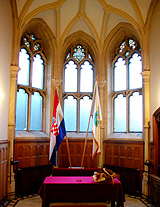 The castle was abandoned for a time during the socialist era, and now houses
the municipal administration of the city of Donji Miholjac. The upper rooms
and halls are mostly occupied with offices, copy machines in the place
of the original furniture, though the walls retain some of the original
ornate wood carved decoration and marble door frames lead to functionary
bathrooms. The ground floor two story grand parlor of oak paneling is used
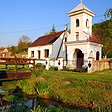
for special events, concerts and readings. What remains of the old castle
is an elongated arcade along the street across next door, somewhat worse
for age, now mostly used for classrooms and storage.
The castle was abandoned for a time during the socialist era, and now houses
the municipal administration of the city of Donji Miholjac. The upper rooms
and halls are mostly occupied with offices, copy machines in the place
of the original furniture, though the walls retain some of the original
ornate wood carved decoration and marble door frames lead to functionary
bathrooms. The ground floor two story grand parlor of oak paneling is used
for special events, concerts and readings. What remains of the old castle
is an elongated arcade along the street across next door, somewhat worse
for age, now mostly used for classrooms and storage.
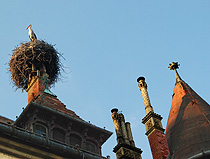 The
Mailath Castle (Dvorac Mailath) is no longer an aristocratic residence
and emperors no
longer come to call, but storks find themselves perfectly at home on
the roof chimneys. Not specifically a tourist destination, the manor can
be
visited on request with the city representatives proud of their legacy.
Also in Donji Miholjac is a lovely 15th Century church of St Michael,
dating from before the Turkish occupation (see Durdevac
Castle Rooster Legend).
The area
around Donji Miholjac is very rich with hunting grounds in the woodlands
and fishing in the nearby Drava River. Donji Miholjac is located northwest
of Osijek (Osijek Tvarda Fortress), five miles from the border with Hungary
and about twenty minutes from Našice (see Pejacevic
Castle). © Bargain
Travel Europe
The
Mailath Castle (Dvorac Mailath) is no longer an aristocratic residence
and emperors no
longer come to call, but storks find themselves perfectly at home on
the roof chimneys. Not specifically a tourist destination, the manor can
be
visited on request with the city representatives proud of their legacy.
Also in Donji Miholjac is a lovely 15th Century church of St Michael,
dating from before the Turkish occupation (see Durdevac
Castle Rooster Legend).
The area
around Donji Miholjac is very rich with hunting grounds in the woodlands
and fishing in the nearby Drava River. Donji Miholjac is located northwest
of Osijek (Osijek Tvarda Fortress), five miles from the border with Hungary
and about twenty minutes from Našice (see Pejacevic
Castle). © Bargain
Travel Europe
Find best hotel and travel deals in Croatia on TripAdvisor
Web
Info
Donji Miholjac
These articles are copyrighted and the sole property of Bargain Travel Europe and WLPV, LLC. and may not be copied or reprinted without permission.
SEE ALSO:
HOTEL CASTLE GJALSKI - KRAPINA-ZAGORJE
LUŽNICA CASTLE – MARY'S COURT CONVENT

