

CARNIVAL IN LUCERNE
Masks, Musicians and Crazy Days
 Okay,
the Carnivals of Germany may be better known to European travelers
(Cologne
Karnival), but the traditions of the pre-lent celebrations
in the Lake Lucerne Region
of central Switzerland have their own curious and wonderful traditions.
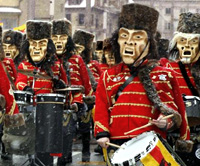
A parade of phantasmagorical musicians – the Guggen Musicians – looking
like something out of the Wizard of Oz, strange characters in odd
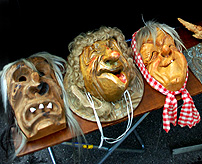
and a bit spooky hand carved wooden masks, the Hubeli. Switzerland is
perhaps more
known
for
its
austere
Protestantism,
but the Catholic traditions of the Lenten calendar are still a good excuse
to party.
Okay,
the Carnivals of Germany may be better known to European travelers
(Cologne
Karnival), but the traditions of the pre-lent celebrations
in the Lake Lucerne Region
of central Switzerland have their own curious and wonderful traditions.
A parade of phantasmagorical musicians – the Guggen Musicians – looking
like something out of the Wizard of Oz, strange characters in odd
and a bit spooky hand carved wooden masks, the Hubeli. Switzerland is
perhaps more
known
for
its
austere
Protestantism,
but the Catholic traditions of the Lenten calendar are still a good excuse
to party.
Luzern Carnival
 The
height of the Lucerne Carnival are the “three craziest days” Dirty
Thursday, Fat Monday and Tuesday, the two days before Ash Wednesday.
The dirty of Thursday is not a moral distinction but means the grease
on farmer’s faces. The farms would slaughter and butcher meat before
winter and the Fasnacht meals would be high calorie greasy sausages,
deep fried desserts and “carnival cakes”. Fat Tuesday (Gudisdienstag)
comes from the word “Gudel“ which means the stomach and belly.
Fat Tuesday was the opportunity to fill up before the end of Carnival
and beginning of lent fasting.
The
height of the Lucerne Carnival are the “three craziest days” Dirty
Thursday, Fat Monday and Tuesday, the two days before Ash Wednesday.
The dirty of Thursday is not a moral distinction but means the grease
on farmer’s faces. The farms would slaughter and butcher meat before
winter and the Fasnacht meals would be high calorie greasy sausages,
deep fried desserts and “carnival cakes”. Fat Tuesday (Gudisdienstag)
comes from the word “Gudel“ which means the stomach and belly.
Fat Tuesday was the opportunity to fill up before the end of Carnival
and beginning of lent fasting.
The Fritschi Parade custom with drummers and pipers leading the Fritschi Society, with its life-sized doll of straw “Brother Fritschi”, followed by armored soldiers dates back to the 15th century, commemorating a military victory at Ragaz in 1446. Like fraternity shenanigans, the people of neighboring Uri, Schwyz and Unterwalden have stolen steal the famous mascot of Lucerne before the Carnival, requiring the Fritschi’s to get him back in time for the parade. The Fritschi Wagon, with a jester, a nursemaid and musicians, decorated with red and yellow flowers, rides through town on Dirty Thursday, throwing oranges to the crowds. The costumed carnival bands (Guuggenmusigen) march in afternoon parade, winding through the old town, down narrow streets and alleyways to stop of brief concerts, with a glass of wine, or a coffee with a dash of Schnapps.
Kriens Masks
The carnival in Lucerne is not only in the main city, but in the towns around the lake and among the hills. While the musicians are the best known feature in Lucerne, where thousands of celebrants fill the streets in bizarre costume, singing and dancing away the chill of winter, in the nearby town of Kriens, at the foot of the slopes of the legendary Mount Pilatus where a the Roman Consul Pontius Pilate is said to be eternally damned, (see Mt Pilatus Railway), the traditions of “Fasnacht” and the wooden masks hold sway.
No-one is quite sure how the traditions of the mask came to be, though it is said they first began to appear about 150 years ago on the estate of the “uf der Muur”. The original masks took the name of Muur or Hübeli masks. There is no strict instruction on the appearance of the masks, each with the distinctive inspiration of the carver, but there are traditionally two types, the cheerful characters with mischievous smiles, suggesting the pleasures of the carnival time reveries and rather more dark fright style masks, perhaps suggesting the opposite side of good and evil. Common characters among the cheerful variety are always present - the Washerwoman (Wöschwyb), the Bernese Woman (Bärnerwyb), the Herbsman (Chrütermandli) and the Old Man (de Alti), along with several others.
The fright masks, with the expression of a devil or demon, typically have large round eyes with emphasized whites, set close together looking down the long pointy nose, big black eyebrows, a pointed chin and white lower-jaw teeth. This mask is worn by the characters the Krienser Deckel and the Farmer (Buuremaa). Why the farmer is so nasty, nobody knows. Maybe somebody stole his crops to make the beer. © Bargain Travel Europe
Find best hotel and travel deals for Lucerne on TripAdvisor
Web
Info
Luzern
Carnival
These articles are copyrighted and the sole property of Bargain Travel Europe and WLPV, LLC. and may not be copied or reprinted without permission.
SEE ALSO:
CRUISING LAKE LUCERNE - SCENIC CRUISES
WALDSTÄTTERHOF HOTELS - LAKE LUCERNE
LUCERNE CHAPEL BRIDGE & WATER TOWER
HOTEL PILATUS KULM - MT PILATUS
BAROQUE JESUIT CHURCH - LUCERNE

