FALL OF THE BERLIN WALL
25 Years and Counting - A Reunited Berlin
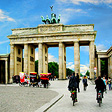
 “Mr.
Gorbachev, tear down this wall!” American President Ronald Reagan
famously demanded in 1987 in front of the Brandenburg Gate. The Soviet
leader didn’t exactly rush forward at the controls of a bulldozer,
and whether the speech had an effect or was simply an example of surfing
on the tides of history, with the collapse of other soviet satellite
states and mass demonstrations for reform in East Germany, the Berlin
Wall did come down, starting on November 9 of 1989.
“Mr.
Gorbachev, tear down this wall!” American President Ronald Reagan
famously demanded in 1987 in front of the Brandenburg Gate. The Soviet
leader didn’t exactly rush forward at the controls of a bulldozer,
and whether the speech had an effect or was simply an example of surfing
on the tides of history, with the collapse of other soviet satellite
states and mass demonstrations for reform in East Germany, the Berlin
Wall did come down, starting on November 9 of 1989.
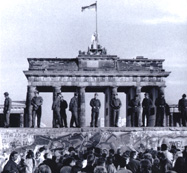 The Berlin Wall wouldn’t
be officially demolished until the summer of 1990, but an off-hand
answer to the question of an Italian journalist by a GDR Public Information
Officer that “free passage” through
all border crossings would be allowed, sent Berliners to test the barriers
that evening.
The answer was a response to Hungary ending border restrictions, effectively
opening a back door to the west. East
German hardliner
The Berlin Wall wouldn’t
be officially demolished until the summer of 1990, but an off-hand
answer to the question of an Italian journalist by a GDR Public Information
Officer that “free passage” through
all border crossings would be allowed, sent Berliners to test the barriers
that evening.
The answer was a response to Hungary ending border restrictions, effectively
opening a back door to the west. East
German hardliner 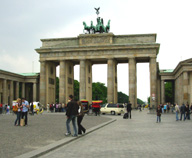 Erich Honecker had resigned after mass public demonstrations
a month before and a
temporary crossing through the wall was opened at the Brandenburg Gate
on December 22, just before Christmas. The wall separating east and
west
Berlin
was
first constructed in 1961,
went through four generations of reconstruction, but today is almost entirely
vanished except for a
sometimes recognizable
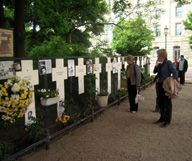
path marked by information stands and a few remaining sections left.
Erich Honecker had resigned after mass public demonstrations
a month before and a
temporary crossing through the wall was opened at the Brandenburg Gate
on December 22, just before Christmas. The wall separating east and
west
Berlin
was
first constructed in 1961,
went through four generations of reconstruction, but today is almost entirely
vanished except for a
sometimes recognizable
path marked by information stands and a few remaining sections left.
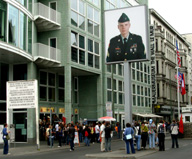 2014 markes the the 25th Anniversary opf the Fall of the Berlin Wall and will be marked by a series of special events, leading up to the November 9th, Anniversary
of the Fall of the Berlin Wall and the “peaceful revolution” in Leipzig that
lead to the reunification of Germany and a divided Berlin. If you can't be there for the big party, but the history and remaining legacy
of the Berlin Wall can be explored at
museums such as the Mauer House - Checkpoint Charlie Museum (see Mauer
Museum at Checkpoint Charlie), the German Historical Museum,
the Kennedys Museum (see Berlin
Kennedys Museum) the Allied Museum, the Berlin Film
Museum (see Film
and Television Museum Berlin),
the Stasi Museum, and the DDR Museum (see DDR
East German Life Museum), the Berlin Technik
Museum
(see Berlin
Airlift at Technik Museum), and the only full remaining
section of the wall next to the Topography of Terror Documentation
Center (see Topography
of Terror)
each featuring parts of the story of this important era of German
History,
allowing
visitors
to explore
all aspects of the division and reunification on Berlin and Germany.
2014 markes the the 25th Anniversary opf the Fall of the Berlin Wall and will be marked by a series of special events, leading up to the November 9th, Anniversary
of the Fall of the Berlin Wall and the “peaceful revolution” in Leipzig that
lead to the reunification of Germany and a divided Berlin. If you can't be there for the big party, but the history and remaining legacy
of the Berlin Wall can be explored at
museums such as the Mauer House - Checkpoint Charlie Museum (see Mauer
Museum at Checkpoint Charlie), the German Historical Museum,
the Kennedys Museum (see Berlin
Kennedys Museum) the Allied Museum, the Berlin Film
Museum (see Film
and Television Museum Berlin),
the Stasi Museum, and the DDR Museum (see DDR
East German Life Museum), the Berlin Technik
Museum
(see Berlin
Airlift at Technik Museum), and the only full remaining
section of the wall next to the Topography of Terror Documentation
Center (see Topography
of Terror)
each featuring parts of the story of this important era of German
History,
allowing
visitors
to explore
all aspects of the division and reunification on Berlin and Germany.
Berlin visitors have a number of ways to actively experience
the history of the Wall and what it meant to Berlin and its inhabitants.
Visit the newly opened Memorial at Bernaur Street (see Berlin Wall Memorial). Take a
GPS-guided walking tours on the trail of the Berlin Wall (MauerGuide.com).
Even without the audio guide, you can follow the wall where information
columns can be found along the former path of the Berlin Wall.
Press the button for audio information in eight languages regarding
the
history of the wall and events related to the specific location
of each column. Take a guided or self-guided bicycle tours on
the Wall path (see Berlin
Fat Tire Bike Tours), visit the hidden underground
Berlin (Berliner-Unterwelten.de),
or take a drive into the east of the city in original GDR Trabant
cars. © Bargain
Travel Europe
Find best hotel and vacation deals in Berlin on TripAdvisor
Web
Info
Visit Berlin
These articles are copyrighted and the sole property of Bargain Travel Europe and WLPV, LLC. and may not be copied or reprinted without permission.
See Also:
ORANIENBURGER - BERLIN PARTY BARS AND PUBS
BERLIN FILM FESTIVAL "METROPOLIS" PREMIERE
BERLIN FILM MUSEUM AT POTSDAMER SONY CENTER
BERLIN
COMMUNICATIONS MUSEUM - ROBOTS
GLOBETROTTER
ODYSSEY HOSTEL

