

LORD BYRON & VILLA
DIODATI
Switzerland's Gothic Summer of 1816 on Lake Geneva
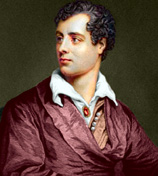 George
Gordon Noel Byron, better known to the world as Lord Byron (the 6th
of that title), perhaps the
most
famous of the English poets representing
the romanticism of the 19th Century, only spent six months in Switzerland,
but much of his work and legend is connected to that land of mountains
and lakes, especially the area surrounding Lake Geneva. Byron had traveled
much already, spinning his journeys to exotic locations into two volumes
of his long narrative poem “Childe Harold's Pilgrimage” -
essentially a travelogue of Byron's own journeys. After traveling from
the Battlefields
at Waterloo (see Waterloo
Battlefield Museums) to Switzerland, his third canto of
that epic work was written while taking residence at a
George
Gordon Noel Byron, better known to the world as Lord Byron (the 6th
of that title), perhaps the
most
famous of the English poets representing
the romanticism of the 19th Century, only spent six months in Switzerland,
but much of his work and legend is connected to that land of mountains
and lakes, especially the area surrounding Lake Geneva. Byron had traveled
much already, spinning his journeys to exotic locations into two volumes
of his long narrative poem “Childe Harold's Pilgrimage” -
essentially a travelogue of Byron's own journeys. After traveling from
the Battlefields
at Waterloo (see Waterloo
Battlefield Museums) to Switzerland, his third canto of
that epic work was written while taking residence at a 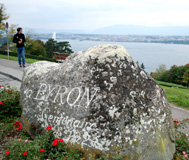 villa
overlooking the lakeshore of Geneva, (Lake Leman) the Villa Diodati,
where
Byron spent the spring and summer months traveling around the lake, following
the footsteps of earlier romantic period author Jean Jacques Rousseau to
Clarens
(Montreux), the setting of Rousseau's "New Heloise", Lausanne, Villeneuve,
and as far as Martigny in the Valais beyond the
lake’s eastern end. His visit to the former Savoy castle at Chillon
near Montreux, upon hearing the travails of a cleric held as a prisoner
there inspired him to write “The Prisoner of Chillon”, a
decidedly romanticist retelling of the actual history (see Chateau
Chillon).
villa
overlooking the lakeshore of Geneva, (Lake Leman) the Villa Diodati,
where
Byron spent the spring and summer months traveling around the lake, following
the footsteps of earlier romantic period author Jean Jacques Rousseau to
Clarens
(Montreux), the setting of Rousseau's "New Heloise", Lausanne, Villeneuve,
and as far as Martigny in the Valais beyond the
lake’s eastern end. His visit to the former Savoy castle at Chillon
near Montreux, upon hearing the travails of a cleric held as a prisoner
there inspired him to write “The Prisoner of Chillon”, a
decidedly romanticist retelling of the actual history (see Chateau
Chillon).
 The
Villa Diodati is perhaps most sought out by fans of Mary Shelley’s “Frankenstein:
or The Modern Prometheus” familiar with the preface of the 3rd
published edition of the novel of the idea coming to her in a “horrible
dream” after a bet among the poets while staying the summer
on Lake Geneva, that they could write as good gothic fiction as the then
popular and notoriously cheap “Penny Dreadfuls” of the time.
Percy Bysshe Shelley and Mary Godwin (he wouldn’t marry her until
after his wife’s suicide) had been to Switzerland before, (see Mary
Shelley in London).
The
Villa Diodati is perhaps most sought out by fans of Mary Shelley’s “Frankenstein:
or The Modern Prometheus” familiar with the preface of the 3rd
published edition of the novel of the idea coming to her in a “horrible
dream” after a bet among the poets while staying the summer
on Lake Geneva, that they could write as good gothic fiction as the then
popular and notoriously cheap “Penny Dreadfuls” of the time.
Percy Bysshe Shelley and Mary Godwin (he wouldn’t marry her until
after his wife’s suicide) had been to Switzerland before, (see Mary
Shelley in London).
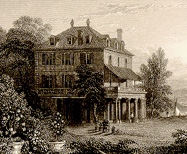 The summer of 1816 was their second
trip, traveling with Mary’s step sister, Claire Claremont, who
had had an affair with Byron in London and was pregnant with his child.
They stayed at the house of Jacob Chapuis, the Maison Chapuis (now gone)
situated
below
the
villa
Byron
was renting. Some of the events of that summer are apocryphal and the
accepted story may have had some artful discretions (see Did Mary Shelley Lie about the origin of Frankenstein?). Mary Shelley
may have been inspired as much by her earlier travels with Shelley as by
the book of German gothic stories for her “nightmare”.
The summer of 1816 was their second
trip, traveling with Mary’s step sister, Claire Claremont, who
had had an affair with Byron in London and was pregnant with his child.
They stayed at the house of Jacob Chapuis, the Maison Chapuis (now gone)
situated
below
the
villa
Byron
was renting. Some of the events of that summer are apocryphal and the
accepted story may have had some artful discretions (see Did Mary Shelley Lie about the origin of Frankenstein?). Mary Shelley
may have been inspired as much by her earlier travels with Shelley as by
the book of German gothic stories for her “nightmare”.
Byron had lost interest in Claire Claremont, Mary Godwin's younger, manic half-sister (who's real name was Jane, but thought Clara or Claire more fitting her romantic soul) who later bore his child, but Byron found a troubled soul mate in a friendship with fellow poet Percy Shelley. The weather was unpleasant early that summer with much rain, thunder and ugly skies reportedly due to the volcanic eruption of Mount Tambora a year before in Indonesia. In the months before, the distant Mont Blanc in the French Alps would be reflected in the waters of the lake, but not so much later that summer, as noted by Byron in his poem “Darkness” - “The bright sun was extinguish’d and the stars did wander darkling in the eternal space”.
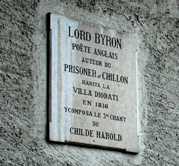 The
Villa Diodati is located in the upscale residential suburb Cologny,
referred to
as the Beverly Hills of Switzerland due to its European celebrity inhabitants
like Isabel Adjani, on the south side
of the
lake from central Geneva (though actually
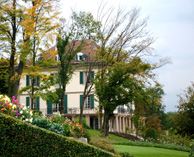
north east by compass). The villa is currently a private
residence, divided into multiple units and not open to the
public. There is a
small open
park next to the property from which a view of the villa can be had,
not much changed from the 19th Century. A large stone at the corner
of the
park commemorates Byron’s stay there. There is a commemorative
plaque as well, but it is actually on the wrong building, next to the
gate along a winding residential road, Chermin de Ruth. The Villa Diodati
(sometimes Diodoti) is the yellow one, down the hill above the Chermin
Byron which passes below. The villa can be reached
by car
along
the Quai
de Cologny to the Rampe de Cologny and wind up the hill to Chermin de
Ruth, or by city bus A or N6 to the Cologny-Mairie stop on the Route
de la Capite, then a short walk downhill on Chermin de Ruth.
The
Villa Diodati is located in the upscale residential suburb Cologny,
referred to
as the Beverly Hills of Switzerland due to its European celebrity inhabitants
like Isabel Adjani, on the south side
of the
lake from central Geneva (though actually
north east by compass). The villa is currently a private
residence, divided into multiple units and not open to the
public. There is a
small open
park next to the property from which a view of the villa can be had,
not much changed from the 19th Century. A large stone at the corner
of the
park commemorates Byron’s stay there. There is a commemorative
plaque as well, but it is actually on the wrong building, next to the
gate along a winding residential road, Chermin de Ruth. The Villa Diodati
(sometimes Diodoti) is the yellow one, down the hill above the Chermin
Byron which passes below. The villa can be reached
by car
along
the Quai
de Cologny to the Rampe de Cologny and wind up the hill to Chermin de
Ruth, or by city bus A or N6 to the Cologny-Mairie stop on the Route
de la Capite, then a short walk downhill on Chermin de Ruth.
Special Anniversary Exibit at the Bodmer Library
Through October of 2016, the Bodmer Library offer presented a special Frankenstein 200th Anniversry Exhibit, including early drafts of the book. For literature and book lovers the nearby Martin Bodmer Foundation is well worth a visit, several blocks back toward Geneva on the Route de la Capite or two bus stops on Bus line A at the Cologny-Temple stop (see Bodmer Collection Library Cologny). Bodmer gathered one of the world’s great private book collections with many magnificent examples now on display in a new collections museum, including Egyptian Papyruses and Illustrated Manuscripts.
Byron left Switzerland in October of 1816 heading on to Italy and then to Greece where we died. To follow the footsteps of Byron in Switzerland, a journey by train (about a hour and a half) to Montreux and Castle Chillon is de rigueur. In Interlaken in the Bernese Oberland one can stay at the Hotel Interlaken (see Hotel Interlaken), where the poet got the inspiration for his dramatic Faustian verse play “Manfred”. © Bargain Travel Europe
Find best hotel and travel deals for Geneva at TripAdvisor
Rail Europe Deal Best
of Lake Geneva & Matterhorn
These articles are copyrighted and the sole property of Bargain Travel Europe and WLPV, LLC. and may not be copied or reprinted without permission.
SEE ALSO:
NEWSTEAD ABBEY - BYRON'S LOST LOVE
FRANKENSTEIN DIARIES BOOK
PATEK
PHILIPPE MUSEUM
SHERLOCK HOLMES MUSEUM - MEIRINGEN
CHATEAU D’AIGLE CASTLE WINE MUSEUM
CHATEAU COPPET - MADAME DE STAEL

