
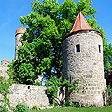

SCHLOSS SOMMERSDORF
Moats and Mummies - Castle Lodgings on the Romantic Road
 It was a scene from a Gothic romance novel of knights errant and the
chivalric days of yore. A wandering poet-knight on a quest happens on
a small but majestic castle, caught in last fading sun's rays and the
cool shades of eve, the cobalt dusk sky reflecting on the still waters
of the wide moat. Crickets prattled in the fresh mown hay and the bull
frogs sang their throaty baritone songs of love. The great gate across
the moat bridge had been closed and secured, yet the visitor knocked
with hope of hospitality. The entreaty was answered by the lord of the
castle and sanctuary granted in the very chamber above the castellan's
own private chambers for a respite from the hardships of travel. A night
spent in the ancient wood-beamed heart of the romantic fortress was rewarded
with a breakfast served in the morning prepared by the very lady of the
castle. Ah, this is no fable of fantasy but a real castle where you can
stay on your own romantic poet's journey.
It was a scene from a Gothic romance novel of knights errant and the
chivalric days of yore. A wandering poet-knight on a quest happens on
a small but majestic castle, caught in last fading sun's rays and the
cool shades of eve, the cobalt dusk sky reflecting on the still waters
of the wide moat. Crickets prattled in the fresh mown hay and the bull
frogs sang their throaty baritone songs of love. The great gate across
the moat bridge had been closed and secured, yet the visitor knocked
with hope of hospitality. The entreaty was answered by the lord of the
castle and sanctuary granted in the very chamber above the castellan's
own private chambers for a respite from the hardships of travel. A night
spent in the ancient wood-beamed heart of the romantic fortress was rewarded
with a breakfast served in the morning prepared by the very lady of the
castle. Ah, this is no fable of fantasy but a real castle where you can
stay on your own romantic poet's journey.
 Schloss
Sommersdorf in the region of Germany known as Franconia in northern
Bavaria, near
where the Romantic Road and the Castle Road cross, seems a world away
and lost in time. The Sommersdorf Castle has been in the von Crailsheim
family since 1550, when Wolf von Crailsheim brought Protestantism to
neighborhood, though the castle origins date back to 1208. The moat and
walls still encircles the castle which comprises the Old Castle, watch
tower, church and the New Castle added in 1750.
Schloss
Sommersdorf in the region of Germany known as Franconia in northern
Bavaria, near
where the Romantic Road and the Castle Road cross, seems a world away
and lost in time. The Sommersdorf Castle has been in the von Crailsheim
family since 1550, when Wolf von Crailsheim brought Protestantism to
neighborhood, though the castle origins date back to 1208. The moat and
walls still encircles the castle which comprises the Old Castle, watch
tower, church and the New Castle added in 1750.  Schloss Sommersdorf is
not a full service castle hotel, rather a lived in private home which
offers bed & breakfast lodging in two guest rooms and three furnished
self catering apartments in the old castle and a former granary, with
their own common rooms for games, television and privacy, making for
a truly unique and mythical medieval castle stay. You won't find any
conference center or meeting rooms at Schloss Sommersdorf, the just peace
and
quiet in the countryside. Two rooms are within
the main castle including the atmospheric Gothic Room on the floor above
the owner’s own private home apartments.
Schloss Sommersdorf is
not a full service castle hotel, rather a lived in private home which
offers bed & breakfast lodging in two guest rooms and three furnished
self catering apartments in the old castle and a former granary, with
their own common rooms for games, television and privacy, making for
a truly unique and mythical medieval castle stay. You won't find any
conference center or meeting rooms at Schloss Sommersdorf, the just peace
and
quiet in the countryside. Two rooms are within
the main castle including the atmospheric Gothic Room on the floor above
the owner’s own private home apartments.
 The
Crailsheims are a large extended family dynasty with a tradition of
public service
and still own several castles. One von Crailsheim was
a high official in the court of King Ludwig II and tried to have him
certified insane for his incessant castle building (see King
Ludwig's Neuschwanstein). The current resident of Castle
Sommersdorf, located in the tiny village of Sommersdorf a few miles from
the A6 autobahn
south
of Ansbach, Baron Manfred Dr. von Crailsheim, retired from his office
in nearby Dinkelsbühl (see Medieval
Dinkelsbuhl) to enjoy his classic cars and maintain
the family property with his wife. If staying at Schloss Sommersdorf
the
good doctor will proudly show you his 1905 Cadillac and 1913 Ford "Tin
Lizzie". He'll even take you for a tour around the beautiful back
roads of the Franconia hills. And if you press him you might even get
a peek at the family mummies!
The
Crailsheims are a large extended family dynasty with a tradition of
public service
and still own several castles. One von Crailsheim was
a high official in the court of King Ludwig II and tried to have him
certified insane for his incessant castle building (see King
Ludwig's Neuschwanstein). The current resident of Castle
Sommersdorf, located in the tiny village of Sommersdorf a few miles from
the A6 autobahn
south
of Ansbach, Baron Manfred Dr. von Crailsheim, retired from his office
in nearby Dinkelsbühl (see Medieval
Dinkelsbuhl) to enjoy his classic cars and maintain
the family property with his wife. If staying at Schloss Sommersdorf
the
good doctor will proudly show you his 1905 Cadillac and 1913 Ford "Tin
Lizzie". He'll even take you for a tour around the beautiful back
roads of the Franconia hills. And if you press him you might even get
a peek at the family mummies!
Okay, back to the mummies in a moment… Franconia, which essentially means the lands of the Franks, the tribe which arose during the 5th Century from the crumbling of the Roman Empire. The most famous of the Franks was Charlemagne, (Karl der Grosse for the Germans) the first Holy Roman Emperor. Charlemagne’s empire was divided into three parts. The easternmost became Germany and the western became France, while those two have been fighting over the middle part ever since, with the last time in World War II. Charlemagne’s empire was the First Reich and Hitler’s idea was to establish the Third Reich, but like the 30 Years War in between, brought devastation and destruction.
 Relatively
rural and sparsely populated, the lands of Franconia are noted for
many of the
remaining walled cities of Germany and castles
which now make up the tourism trails of castle routes and romantic era,
like Rothenburg ob der Tauber, Dinkelsbuhl and Nuremberg. The little
village of Feuchtwangen (meaning "Wet Cheeks") a kilometer
away is legendarily where Charlemagne got lost and stopped to splash
water on his face. Franconia also saw a lot of troop movements of Napoleon.
The battle of Austerlitz was Napoleon’s greatest victory (see Napoleon’s
Tomb) and Leipzig one of his most significant defeats. It
was Napoleon who ceded parts of Franconia to his ally Bavaria (see Ludwigsburg
Palace).
Relatively
rural and sparsely populated, the lands of Franconia are noted for
many of the
remaining walled cities of Germany and castles
which now make up the tourism trails of castle routes and romantic era,
like Rothenburg ob der Tauber, Dinkelsbuhl and Nuremberg. The little
village of Feuchtwangen (meaning "Wet Cheeks") a kilometer
away is legendarily where Charlemagne got lost and stopped to splash
water on his face. Franconia also saw a lot of troop movements of Napoleon.
The battle of Austerlitz was Napoleon’s greatest victory (see Napoleon’s
Tomb) and Leipzig one of his most significant defeats. It
was Napoleon who ceded parts of Franconia to his ally Bavaria (see Ludwigsburg
Palace).
Mummy Crypt at Sommersdorf Castle
 It
was while Napoleon’s troops stopped at Sommersdorf in 1806,
that they discovered five coffins in the family crypt under the castle’s
church. The coffins contained well preserved mummified remains, four
of them family members, and one a Swedish army colonel Baron von Holz,
from the 30 Years War (see Heidelburg
Castle),
found still wearing his boots. One of the mummies was buried alive, the
Baroness von Kniestett, who became ill
after the birth
It
was while Napoleon’s troops stopped at Sommersdorf in 1806,
that they discovered five coffins in the family crypt under the castle’s
church. The coffins contained well preserved mummified remains, four
of them family members, and one a Swedish army colonel Baron von Holz,
from the 30 Years War (see Heidelburg
Castle),
found still wearing his boots. One of the mummies was buried alive, the
Baroness von Kniestett, who became ill
after the birth 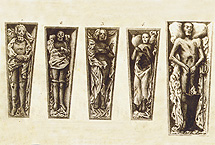 of a child and
thought to have died, but the clenched fingers of her mummified corpse
show that she was buried too soon. Why
the mummies were naturally preserved is still an unsolved mystery. To
preserve them from deterioration the coffins are no longer opened for
casual inspection, but the good baron will take you into the crypt for
a look at the coffins, which remain were they have rested for 300 years,
although a couple of them went on a tour of museums in America (see Mummies
of the World LA).
of a child and
thought to have died, but the clenched fingers of her mummified corpse
show that she was buried too soon. Why
the mummies were naturally preserved is still an unsolved mystery. To
preserve them from deterioration the coffins are no longer opened for
casual inspection, but the good baron will take you into the crypt for
a look at the coffins, which remain were they have rested for 300 years,
although a couple of them went on a tour of museums in America (see Mummies
of the World LA).
A stay at Schloss Sommersdorf offers an opportunity for lots to explore. Passing just outside of Sommersdorf is the former Roman boundary known as the Limes (see Roman Limes Road Germany). Within easy reach are colorful medieval towns of the Romantic Road (see Romantic Road Touring), the Neckartal valley (see German Castle Road), the Altmuhltal Nature Park, cities of Ansbach with its connection to the American Revolution Battle of Yorktown, a few miles to the north, the great walled city of Nuremberg, and Wolframs-Eschenbach, a town once a stronghold of the Teutonic Knights, named for Germany's epic poet Wolfram von Eschenbach, author of the legend of "Parsifal", one of the Minnesänger (see Wartburg Castle) minstrel poets who roamed medieval Franconia with their songs of love and chivalry, who was born there and is buried in the town church.
Reservations for Schloss Sommersdorf can be made online through Culture-Castles, a collection of historic castle and manor house residences let out as hotel accommodations in Germany and the Netherlands, or by query through the website. Prices are from €100 to €140 per night with a three night minimum stay. Schloss Sommersdorf is just under two hours from Munich or Frankfurt by car. The nearest rail station is Triesdorf-Merkendorf about 4 miles away, a little over two hours from Munich, but public transportation is limited to local rural bus service. But that's why you come to Middle Franconia isn't it, to getaway off-the-beaten track. © Bargain Travel Europe
Best hotel and vacation deals in Franconia Bavaria on TripAdvisor
Web Info
Schloss Sommersdorf
These articles are copyrighted and the sole property of Bargain Travel Europe and WLPV, LLC. and may not be copied or reprinted without permission.
See Also:
HOTEL
MARKUSTURM - ROTHENBURG OB DER TAUBER
SCHLOSS EGGERSBERG CASTLE HOTEL ALTMUHLTAL
SCHLOSS LUDWIGSECK - CASTLE BED & BREAKFAST
JOHANNISBURG
PALACE - ASCHAFFENBURG

