




CASTLE HEDINGHAM - HALSTEAD
The DeVeres' Great Norman Keep of Essex
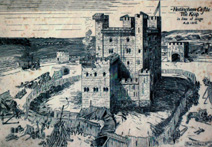
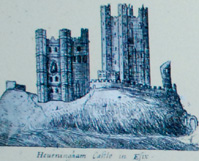
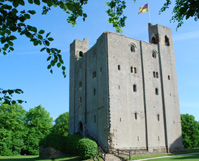 The DeVere family goes back to the Norman conquest of 1066. Alberic DeVere was the brother-in-law and a favorite knight of William the Conqueror, given a collection of lands in Middelsex after the Battle of Hastings. The first Aubrey DeVere was created the Earl of Oxford in 1103, despite his lands being in Essex, while the Earl of Essex's lands were in Oxford - but that's another matter. The Castle at Hedingham was built in 1140 by the second Aubrey DeVere, who was killed in a London riot while it was being constructed. It was once somewhat larger with an attached entrance gate complex, but the square keep which remains today is perhaps the best preserved original Norman keep in England, singular and formidable.
Birthplace of "Real" Shakespeare Earl of Oxford?
 Hedingham Castle also holds a peculiar place in a literary mystery. Depending on one’s point of view, this may be the real birthplace of Shakespeare. Edward DeVere, the 17th Earl of Oxford, one of the principal candidate in the undying Shakespearian authorship debate, and even presented in a Hollywood movie on the subject was, born at Hedingham Castle on April 8, 1550. Recently a portrait was miraculously “discovered” of a crisply dressed Elizabethan man in collared shirt and put on tour as a portrait of the William Shakespeare of Stratford-Upon-Avon. The portrait in question was almost bought by a descendant of the DeVere family as a portrait of Edward DeVere, the 17th Earl of Oxford. You, dear reader of these presents, may not care a groatsworth for the intrigues of literary authorship controversies, but may find a visit to the DeVere family ancestral castle an entertaining experience just the same.
The DeVeres
 The
DeVeres were a rich and powerful family in medieval England. The second
Earl of Oxford
fought the crusades with Richard II “The
Lion Heart” (see Varazdin
Castle Croatia) and the 3rd Earl was
among the barons who forced King John to sign the Magna Carta, while
King John later besieged the castle at Hedingham. The 13th Earl of Oxford,
John DeVere led Henry VII’s army to defeat Richard III (see York
Wall Walks) at the Battle of Bosworth and the 15th Earl
was Henry VIII’s
Lord Chamberlain. The
17th Earl, Edward DeVere of the
The
DeVeres were a rich and powerful family in medieval England. The second
Earl of Oxford
fought the crusades with Richard II “The
Lion Heart” (see Varazdin
Castle Croatia) and the 3rd Earl was
among the barons who forced King John to sign the Magna Carta, while
King John later besieged the castle at Hedingham. The 13th Earl of Oxford,
John DeVere led Henry VII’s army to defeat Richard III (see York
Wall Walks) at the Battle of Bosworth and the 15th Earl
was Henry VIII’s
Lord Chamberlain. The
17th Earl, Edward DeVere of the  Shakespeare controversy, born at Hedingham
Castle April 8, 1550, handsome, arrogant and funny,
was one of Elizabeth’s
favorites, at least early on. One tantalizingly salacious
theory has
it that the Bard of Avon’s reputed patron the 3rd Earl of Southampton
was actually the illegitimate issue of Queen Elizabeth and Edward DeVere,
resulting in DeVere’s travels to Italy (indiscretions banishment?),
where he fought in tournaments (apparently a rather good jouster) and
did a fair bit of bed-hoping among the Montagus and Capulets.
Though,
Elizabeth
was later disenchanted with DeVere when he refused to
command
the port
city
of
Harwich during
the
assault
of
the
Spanish Armada (see Derry
Tower Museum Armada).
Shakespeare controversy, born at Hedingham
Castle April 8, 1550, handsome, arrogant and funny,
was one of Elizabeth’s
favorites, at least early on. One tantalizingly salacious
theory has
it that the Bard of Avon’s reputed patron the 3rd Earl of Southampton
was actually the illegitimate issue of Queen Elizabeth and Edward DeVere,
resulting in DeVere’s travels to Italy (indiscretions banishment?),
where he fought in tournaments (apparently a rather good jouster) and
did a fair bit of bed-hoping among the Montagus and Capulets.
Though,
Elizabeth
was later disenchanted with DeVere when he refused to
command
the port
city
of
Harwich during
the
assault
of
the
Spanish Armada (see Derry
Tower Museum Armada).
 One
will find no evidence of Shakespearean authorship at Hedingham. What
contributes to the mystery
is indeed what you will not find at Hedingham.
For one of England’s great families, the Hedingham keep
seems so bare and austere, certainly in comparison to Edward DeVere’s
father-in-law, William Cecil, Lord Burghley’s great Elizabethan
palace, Burghley House in Lincolnshire (see Burghley
House). The castle
at Hedingham retains its pure Norman architecture partly because it was
never directly
added
to like many other English castles. Instead, a great Tudor Manor house
was built next to the castle in which the
One
will find no evidence of Shakespearean authorship at Hedingham. What
contributes to the mystery
is indeed what you will not find at Hedingham.
For one of England’s great families, the Hedingham keep
seems so bare and austere, certainly in comparison to Edward DeVere’s
father-in-law, William Cecil, Lord Burghley’s great Elizabethan
palace, Burghley House in Lincolnshire (see Burghley
House). The castle
at Hedingham retains its pure Norman architecture partly because it was
never directly
added
to like many other English castles. Instead, a great Tudor Manor house
was built next to the castle in which the 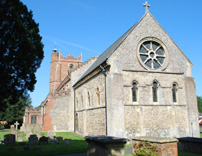 Earls of Oxford lived, but
the great mansion called the Brick Tower was torn down and sold, mostly
to satisfy the poet Earl’s lavish lifestyle and bad investments
- perhaps his losses in theatrical ventures - with only excavations from
the 1800s to be found today. The Rose Window of the brick tower Great
Chamber is believed to be seen in the Church of St Nicholas in the little
village of Castle Hedingham. A detailed stone relief depicting the battle
of Bosworth, once over the main fireplace is now at Stowe School in Buckinghamshire,
though the brick tower’s vaulted cellars under the excavated foundations
still remain in remarkable condition
Earls of Oxford lived, but
the great mansion called the Brick Tower was torn down and sold, mostly
to satisfy the poet Earl’s lavish lifestyle and bad investments
- perhaps his losses in theatrical ventures - with only excavations from
the 1800s to be found today. The Rose Window of the brick tower Great
Chamber is believed to be seen in the Church of St Nicholas in the little
village of Castle Hedingham. A detailed stone relief depicting the battle
of Bosworth, once over the main fireplace is now at Stowe School in Buckinghamshire,
though the brick tower’s vaulted cellars under the excavated foundations
still remain in remarkable condition
The Keep
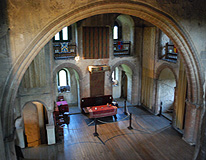
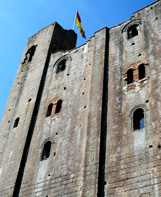 Castle Hedingham's Norman keep is 110 feet high, with four floors to explore, including the great Banqueting Hall which is supported by one of the largest Norman arches in England, which can be viewed from the Minstrels' Gallery above. On the top floor the current owners of Castle Hedingham, the Lindseys, who are descendents of the DeVere family, have created a quite detailed history of the castle and life there in Norman times. The structure of the Hedingham Keep survived its two 13th Century sieges due to 12 foot thick walls, which taper to 20 feet wide below ground, making them almost impossible undermine. After weeks of being besieged, fresh fish were thrown from the ramparts to the King John's attacking troops below to show the castle still had food. The fish were fetched through a secret tunnel to the fish ponds, still visible today. Though, the fish trick unfortunately didn't keep the castle from being taken.
 The
title of the Earl of Oxford ended in 1703 with the death of the
last Aubrey leaving no male heirs. The only remaining
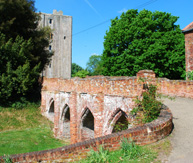
above ground structure from the Tudor period is the brick bridge over
the dry moat, from the 18th Century Georgian house built by the property’s
later inhabitant Sir William Ashhurst,
literally a bridge between the centuries.
The
title of the Earl of Oxford ended in 1703 with the death of the
last Aubrey leaving no male heirs. The only remaining
above ground structure from the Tudor period is the brick bridge over
the dry moat, from the 18th Century Georgian house built by the property’s
later inhabitant Sir William Ashhurst,
literally a bridge between the centuries.
Castle Hedingham Events
Various events are held at Castle Hedingham during the year, knights jousting tournaments and car enthusiast weekends. In October, Hedingham Castle is starting a new ghost haunt experience called Haunting Hedingham. The castle does a brisk business as a spot for weddings, with packages including a civil ceremony in the great hall where Queen Elizabeth and Henry VIII were once entertained, use of the family’s 1956 Rolls Royce Silver Cloud and wedding party accommodation in the estate’s Georgian House.
Visiting Castle Hedingham
Castle Hedingham
is closed on Fridays and Saturdays and when weddings are held. Admission
for adults is £5 during regular opening times
Sunday 10am to 5pm and Monday to Thursday 11am to 4pm with a family ticket
for £17. Special event weekends are £8 and £10 depending
on the event. If visiting Castle Hedingham, a stroll around the village
just across the street from the property which was originally part of
the outer bailey and still has 16th Century half-timbered houses on the
old square. Castle Hedingham is addressed as part of the nearby town
of Halsted, which was closer to the main coach road, less than two hours
from London, about 20 minutes from Stansted. Fifteen minutes
to the north east, in Sussex, the town of Lavenham has a strong DeVere
connection,
with
its
magnificent
church
funded by
John DeVere and money from the town’s
burgeoning medieval wool trade (see Lavenham
Medieval Village), one of
the best surviving medieval towns of England,
with
its
historic Swan Hotel. © Bargain
Travel Europe
Find
best hotel & travel deals in Suffolk
East Anglia
Web Info
Castle Hedingham
These articles are copyrighted and the sole property of Bargain Travel Europe and WLPV, LLC. and may not be copied or reprinted without permission.
See Also:
SHAKESPEARE BIRTHPLACE - THE STRATFORD MAN
LAVENHAM'S
SWAN HOTEL
WARWICK
CASTLE - TUDOR AGE GHOSTS
LORD
BYRON'S NEWSTEAD ABBEY
KING
JOHN’S CASTLE - LIMERICK

