


LAUGHARNE CASTLE
Romantic’s Ruin on the South Welsh Coast
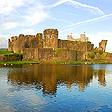
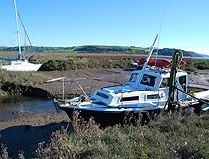
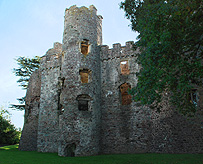 It sits with a brooding presence on a promontory hill with a view over the estuary of the River Tâf with its mud flats when the tide goes out, stranding boats among the high marsh grasses, or roiling with waves in heavy storms. One of the most beautiful of settings when the light is right, the ruins of Laugharne Castle have inspired romantic artists and poets for centuries. The English romatic artist William Turner painted it and the poet, Dylan Thomas wrote poems in its garden. Thomas fell so in love with the environment, he lived there, first in a guest house then his own (see Dylan Thomas Boathouse).
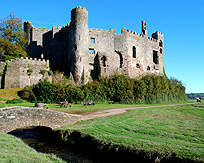 Laugharne Castle, located between Swansea and Tenby has had a very rocky and troubled history, taken, destroyed, rebuilt and lost again several times. It was first built in 1116 as an Anglo-Norman earthwork fortification on the southern shores of Wales by Robert Courtemain. In 1171, Plantagenet King Henry II met with Rhys ap Gruffudd to settle a peace treaty, between the Normans and the Welsh, but Henry died 18 years later and Gruffudd assaulted the castle, burning it. The castle was rebuilt and in 1215 was captured again by Llewellyn the Great in his Welsh revolt. Guy de Brian acquired the castle and lands under King Henry III and rebuilt it in stone forming the basis for its present shape, and added to by successions of de Brians until the mid-14th Century.
 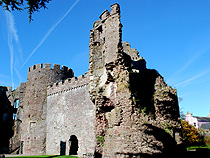 The last de Brian distinguished himself in the battle of Crécy under Edward III
and was made a Knight of the Garter, but when he died with no clear heir, the castle fell into decline. Almost a hundred years later, Laugharne Castle finally passed to the Earls of Northumberland, then in 1575, Queen Elizabeth I granted the property to Sir John Perriot, rumored to be an illegitimate son of Henry VIII. It was Sir John who began to transform the old medieval ruin into a Tudor manor house, but Sir John found himself on the wrong side of Elizabeth, found guilty of treason and thrown into the tower (see Tower
of London).
The last de Brian distinguished himself in the battle of Crécy under Edward III
and was made a Knight of the Garter, but when he died with no clear heir, the castle fell into decline. Almost a hundred years later, Laugharne Castle finally passed to the Earls of Northumberland, then in 1575, Queen Elizabeth I granted the property to Sir John Perriot, rumored to be an illegitimate son of Henry VIII. It was Sir John who began to transform the old medieval ruin into a Tudor manor house, but Sir John found himself on the wrong side of Elizabeth, found guilty of treason and thrown into the tower (see Tower
of London).
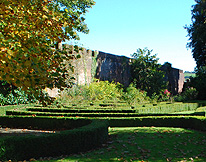 The garden of Laugharne Castle in its outer ward was one of its best known features. The first garden was likely first created by John Percy and recreated in Victorian style by Elizabeth Ravenscroft who inherited it in the 18th Century. Not a lot of the original garden remains except some hedges and decorative stonework among the growth of shade trees embracing the shattered partial walls where light cascades as the sun passes and the gazebo where Dylan Thomas sat with his notepad to scratch out the lines to 'Portrait of the Artist' on the medieval foundation stones. The entrance to the castle with a shop in the former gatehouse has an historical reconstruction model of the castle as it once stood before the ravages of time and a printed history guide available.
Visiting Laugharne Castle
 The castle ruins of Laugharne are open from daily from 10am to 5pm, from
the end of March 27 to the end of October. Admission is £3.80 for
adults, £2.85 Seniors and Students and £11.40 for a family ticket. Welsh
resident seniors and kids with a pass are free. There is street parking
and a lot along the estuary shore. There is a picnic area below the high
walls along the shore and several restaurants and taverns are nearby
in the small village. The Seaview Guesthouse where Dylan Thomas lived
on his visits to Laugharne is right behind the castle with a AA 2 Rosette
restaurant and rooms. The Dylan Boathouse is a five minute walk along
the shore cliff. © Bargain
Travel Europe
The castle ruins of Laugharne are open from daily from 10am to 5pm, from
the end of March 27 to the end of October. Admission is £3.80 for
adults, £2.85 Seniors and Students and £11.40 for a family ticket. Welsh
resident seniors and kids with a pass are free. There is street parking
and a lot along the estuary shore. There is a picnic area below the high
walls along the shore and several restaurants and taverns are nearby
in the small village. The Seaview Guesthouse where Dylan Thomas lived
on his visits to Laugharne is right behind the castle with a AA 2 Rosette
restaurant and rooms. The Dylan Boathouse is a five minute walk along
the shore cliff. © Bargain
Travel Europe
Compare hotel and travel deals in Laugharne on TripAdvisor
Web Info
Cadw
Wales
These articles are copyrighted and the sole property of Bargain Travel Europe and WLPV, LLC. and may not be copied or reprinted without permission.
SEE ALSO:
PEMBROKE
CASTLE
CAERPHILLY
CASTLE
PLANTAGENET SOCIETY TOURNAMENT EVENTS

