
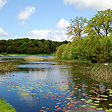


KILKENNY CASTLE
Norman Castle to Victorian Baronial Palace
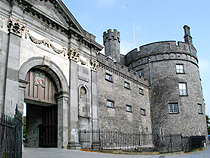 One of Ireland’s most important and most visited castles about an hour from Dublin sits on a crossing of the River Nore in the center of Kilkenny. The original dates for a first fortress on the spot vary, with likely an earlier home of the Irish Kings of Ossory and the Celts before them, but the first significant castle, likely of wood, was built by Richard de Clare “Strongbow” who first established the Anglo-Norman presence in Ireland in the 12th Century. William Marshal, the crusader hero under Henry II and protector of his son and later king, John, married Strongbow’s daughter Isabel (see Ros
Tapestry)
and succeeded to his father-in-law’s lands in 1189 (see Pembroke
Castle Wales). It was Marshal who built the square stone
Norman castle, begun in 1195 and completed in 1213
One of Ireland’s most important and most visited castles about an hour from Dublin sits on a crossing of the River Nore in the center of Kilkenny. The original dates for a first fortress on the spot vary, with likely an earlier home of the Irish Kings of Ossory and the Celts before them, but the first significant castle, likely of wood, was built by Richard de Clare “Strongbow” who first established the Anglo-Norman presence in Ireland in the 12th Century. William Marshal, the crusader hero under Henry II and protector of his son and later king, John, married Strongbow’s daughter Isabel (see Ros
Tapestry)
and succeeded to his father-in-law’s lands in 1189 (see Pembroke
Castle Wales). It was Marshal who built the square stone
Norman castle, begun in 1195 and completed in 1213
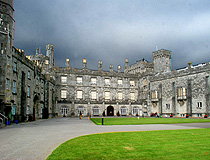 Unlike
Norman keep castles like Bunratty (see Bunratty
Castle), Kilkenny
was constructed as a square of walls with four round corner towers,
more akin to the fortress designs of the Welsh coast (see Harlech
Castle), and surrounded by a moat, which form the basis of the current castle. Inside the walls were wooden constructed halls, living quarters and barracks. Unlike the other Norman castles in Ireland (see Trim
Castle) which decayed into ruin over time, Kilkenny remained a major residence and seat of wealth, and transformed over centuries into a castellated baronial manor house, with the castle defenses exchanged for parkland and gardens. Three of the original towers remain, but much of the castle has been added to with later Victorian age remodeling.
Unlike
Norman keep castles like Bunratty (see Bunratty
Castle), Kilkenny
was constructed as a square of walls with four round corner towers,
more akin to the fortress designs of the Welsh coast (see Harlech
Castle), and surrounded by a moat, which form the basis of the current castle. Inside the walls were wooden constructed halls, living quarters and barracks. Unlike the other Norman castles in Ireland (see Trim
Castle) which decayed into ruin over time, Kilkenny remained a major residence and seat of wealth, and transformed over centuries into a castellated baronial manor house, with the castle defenses exchanged for parkland and gardens. Three of the original towers remain, but much of the castle has been added to with later Victorian age remodeling.
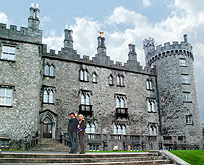 A symbol of the Norman occupation and English power in Ireland, the castle was bought in 1391 by James Butler, 3rd Earl of Ormonde. The Butler family ruled the surrounding countryside for almost five hundred years, gaining significant land holdings with the dissolution of the monasteries by Henry VIII (see Jerpoint Abbey). Kilkenny Castle was the site of the meeting of the General Assembly of the Catholic Confederate goverment of Ireland in the 1640s, and suffered badly under siege by Cromwell's forces in 1650, during which one of the towers was apparently destroyed.
 It is claimed Kilkenny Castle is notoriously haunted, with ghosts supposedly not allowing anyone to sleep overnight in comfort in the last 150 years. One suspects there are likely other causes for that, perhaps more economic than spectral, but the castle did attract the interest of famed British occultist Aleister Crowley, who bought a part interest in the castle from the last Bulter when the family fell on hard times in the market crash of the 1930’s. Details on ghosts at Kilkenny Castle are sparse, a "lady in white" seems to be occassionally spotted on the stairs and in the gardens. There is a local Ghost Walk Tour of Kilkenny town which gathers at the castle gates.
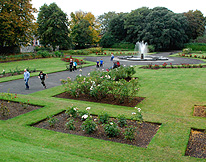
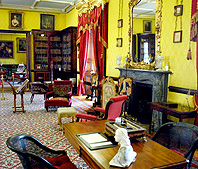 Kilkenny Castle was granted to a trust in 1968 and extensive refurbishments made. Most of the original Butler furnishings were sold off at auction in 1935, but some were re-acquired and added to by paintings from the Irish National Gallery. The castle and grounds are now managed by the OPW, with regular tours, and the gardens and parkland adjoining the castle open to the public. The Rose Garden on the city side of the castle is used as the location for weddings against the backdrop of the castle towers. The expansive green grass park extends from the eastern side along the river bank, and is popular for weekends.
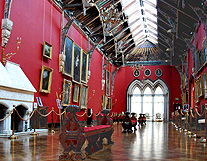 Tours of the interior of the castle lead through a number of 17th to 19th century palace style rooms of rich furnishings and paintings. Portraits of the various Butlers are omni-present. The Blue Bedroom and Chinese Bedroom are of particular fascination, but perhaps the most impressive room is the Roberton Picture Galley. Designed by architect William Robertson in the early 1800’s, where a wing was added to the castle over earlier foundations with a long picture gallery. A high arched ceiling with skylights was added later, giving the chamber a grand scale. The earlier medieval heritage life of the castle can be found in the undercroft of the west tower with a massive cirular chamber of thick 13th Century walls and arrow loops. In the Medieval Room of the south tower, visitors can view an audio visual presentaion of the history of the castle.
Visiting Kilkenny Castle
Kilkenny Castle is open for guided tours only, from October to March and April to May, daily from 10.30am to 5pm (though closed for lunch from 12.45 to 2.00pm). From June to August, tours are offered from 9.30am to 7.pm and in September from 10am to 6.30pm. Admission for adults is €7, Seniors €5, Students and Children over 6 are €3, with a family ticket for €17. The exterior grounds are open without charge. Tours take about an hour. Kilkenny Castle is very popular tourist spot and waits can get long in the summer months. © Bargain Travel Europe
Find best hotel and travel deals in Kilkenny on TripAdvisor
Web
Info
Kilkenny
Castle
These articles are copyrighted and the sole property of Bargain Travel Europe and WLPV, LLC. and may not be copied or reprinted without permission.
SEE ALSO:
SMITHWICK’S BREWERY TOUR KILKENNY
ABBEY HOUSE B&B - JERPOINT ABBEY VIEW

