
THE
RHINE BY TRAIN - THE ROMANTICS TOUR
Switzerland and Germany with a Rail Pass
 There
are lots of ways to explore Europe. Here is one idea. Follow the Rhine
River by
train. In 1814, the poet Percy Shelley and Mary Godwin
eloped from London - two years before the famous summer of 1816 in Geneva
(see Villa
Diodati) when Mary Shelley started her novel
of Frankenstein - sailed to Paris, then walked and rode donkey carts
to Switzerland,
finding
themselves
in Brunnen on Lake Lucerne, when Shelley’s money was running out,
and were left with only £28. According to Mary’s journal (see Mary Shelley Frankenstein Author Memoir), traveling
by rivers was the cheapest form of travel, “that by taking advantage
of the rivers of the Reuss and Rhine, we could reach England without
traveling a league on land”. Over the next weeks the literary Romantics
made the rather perilous journey by boat over river rapids and waterfalls
back home through Switzerland and Germany to sail home. There are still
river cruise boats traveling parts of that journey, but if the modern
European rail system existed in the early 19th Century that trip would
have been made by train. And for the modern traveler with a little romance
in the soul, why not follow in the footsteps of the Romantics.
There
are lots of ways to explore Europe. Here is one idea. Follow the Rhine
River by
train. In 1814, the poet Percy Shelley and Mary Godwin
eloped from London - two years before the famous summer of 1816 in Geneva
(see Villa
Diodati) when Mary Shelley started her novel
of Frankenstein - sailed to Paris, then walked and rode donkey carts
to Switzerland,
finding
themselves
in Brunnen on Lake Lucerne, when Shelley’s money was running out,
and were left with only £28. According to Mary’s journal (see Mary Shelley Frankenstein Author Memoir), traveling
by rivers was the cheapest form of travel, “that by taking advantage
of the rivers of the Reuss and Rhine, we could reach England without
traveling a league on land”. Over the next weeks the literary Romantics
made the rather perilous journey by boat over river rapids and waterfalls
back home through Switzerland and Germany to sail home. There are still
river cruise boats traveling parts of that journey, but if the modern
European rail system existed in the early 19th Century that trip would
have been made by train. And for the modern traveler with a little romance
in the soul, why not follow in the footsteps of the Romantics.
Secret Memoirs of Mary Shelley Audiobook Coming Soon
The best way to make this a viable and cost effective trip is with a Eurail Rail Pass (see How Rail Passes Work). The Select Pass or Saver Pass (for two traveling together) allows the choice of countries to travel through and a number of days of travel. One version is for consecutive days, the other for a number of days of travel to be used within a two month period. What you choose will depend on how many stops you want make. After all, you’re planning your own trip with the freedom of the Romantics. Travel a bit, then stop and explore, a little farther, stop and explore. You could get point to point tickets, but a rail pass allows the freedom to get off and on and travel when you like. Show up at the station and get on a train, or arrive in a city and take excursion trains for that day. If you want to explore 5 cities or regions get 6 or 8 days of travel on the pass, the select pass goes up to 14 days of travel.
Following the Rhine River Route
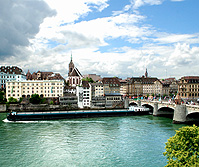
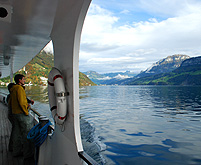 The Rhine
River begins in the Alps of Graubunden in southeast Switzerland, where
it is a swift
flowing roil of ice green rapids, sometimes called
the “Baby Rhine”, then flows north past Liechtenstein (see Prince's
Wine Cellars) to Lake Constance (the Bodensee), then between
the German Black Forest and Switzerland, over the Rhinefalls (see Schaffhausen Rhine Falls) to Basel,
where
it
turns north, flattening to the wide familiar great river between Germany
and France's Alsace, past Mannheim and Mainz to Koblenz (called the “Middle
Rhine” with all the castles and the Loreley), to Cologne and Dusseldorf
and out to the north sea. For this trip you could make do with a two
country pass for Switzerland and Germany only. If you wanted to venture
into the French Alsace you could add France, of if you wanted to explore
Holland, Belgium or Luxemburg, add Benelux. You don’t have to strictly
stay to the Rhine, it’s not a rule, there are lots of possibilities
for exciting touring variety.
The Rhine
River begins in the Alps of Graubunden in southeast Switzerland, where
it is a swift
flowing roil of ice green rapids, sometimes called
the “Baby Rhine”, then flows north past Liechtenstein (see Prince's
Wine Cellars) to Lake Constance (the Bodensee), then between
the German Black Forest and Switzerland, over the Rhinefalls (see Schaffhausen Rhine Falls) to Basel,
where
it
turns north, flattening to the wide familiar great river between Germany
and France's Alsace, past Mannheim and Mainz to Koblenz (called the “Middle
Rhine” with all the castles and the Loreley), to Cologne and Dusseldorf
and out to the north sea. For this trip you could make do with a two
country pass for Switzerland and Germany only. If you wanted to venture
into the French Alsace you could add France, of if you wanted to explore
Holland, Belgium or Luxemburg, add Benelux. You don’t have to strictly
stay to the Rhine, it’s not a rule, there are lots of possibilities
for exciting touring variety.
Trains
Curiously German DB (Deutschbahn) trains operate in Switzerland, but Swiss trains (SBB) don’t generally venture into Germany. One can speculate whether this is due to Swiss neutrality and Germany’s historic tendency for adventure beyond its borders (ahem), but it does make route planning a bit simpler. You can use either the DB website for route selection or the Swiss SBB site for Switzerland, these two sites are the clearest and most detailed in English (best to use the DB site if you want to venture into France or Holland from Germany, the SBB if from Switzerland) and each site will have more detail and more trains listed for their own country. If you have a rail pass, you don’t need to purchase tickets through these sites, just use them to plan routes and times. With a pass you show up and get on the train you want. Once on board, the German DB trains provide a Travel Plan (Reiseplan) which lists the stops and schedule times, with connections, times and tracks (Gleis) to other destinations from each stop.
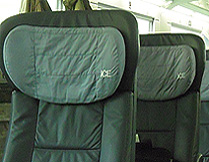 Trains you’ll
encounter have designations like EC (Eurocity), IC (Intercity), ICE
(Intercity Express) this is the German high speed
train, (the France version is the TGV), in Switzerland there is also
an ICN, this is just a newer Intercity train that leans in the turns.
These
trains
will
appear
on
the train
schedule boards in red bold type and are the direct faster trains. The
IR (Inter Regional) and RE (Regional) trains are the locals with lots
of stops, generally a slower trip, though some of the places you’ll
want to stop are regional stations and for short distances, speed doesn't
matter that much. The trains in the direction you're going
will generally run every hour (or half hour) to major cities, smaller
towns
may be longer
in between train. For some of the specific trains listed here, like the
ICEs or ECs they run twice or few times a day. You don't have get back
on the same daily train, but can just follow the route.
Trains you’ll
encounter have designations like EC (Eurocity), IC (Intercity), ICE
(Intercity Express) this is the German high speed
train, (the France version is the TGV), in Switzerland there is also
an ICN, this is just a newer Intercity train that leans in the turns.
These
trains
will
appear
on
the train
schedule boards in red bold type and are the direct faster trains. The
IR (Inter Regional) and RE (Regional) trains are the locals with lots
of stops, generally a slower trip, though some of the places you’ll
want to stop are regional stations and for short distances, speed doesn't
matter that much. The trains in the direction you're going
will generally run every hour (or half hour) to major cities, smaller
towns
may be longer
in between train. For some of the specific trains listed here, like the
ICEs or ECs they run twice or few times a day. You don't have get back
on the same daily train, but can just follow the route.
Switzerland
In Switzerland,
you can of course take Swiss trains with your multi-country pass, but
the
German railway operates trains along these routes. To strictly
follow the Rhine, the DB Eurocity EC6 begins in Chur (see Design
Bars and Romantic
Stern), Switzerland and follows
the young Rhine River the most directly for a major train route all the
way
to
Cologne
(Koln). To go to Lake
Constance and the Rhinefalls at Schaffhausen,
you’d
need to take a Swiss IR train via Arbon (see Arbon
on Bodensee)
and Romanshorn. The Shelleys started their journey in Brunnen on Lake
Lucerne where the Reuss
River empties into the Rhine. Lake Lucerne is one of the most beautiful
of Switzerland, and Lucerne one of the most beautiful cities in the world
with lots to do and explore (see Swiss
Transport Museum).
You could start from Lucerne and take a paddle steamer down the lake
to Fluelen, then
by train to Basel via Zurich. This is part of the Swiss Rail Wilhelm
Tell Express route (see Wilhelm
Tell Express). The boat ride in Switzerland
will be included with your rail pass. The German ICE 370 starts in Interlaken,
not strictly on the Rhine, but one of Switzerland’s most popular
tourist spots (see Switzerland Grand Tour by Train), with the Jungfrau, Eiger (see Jungfraujoch)
and Schilthorn (see Schilthorn
Piz Gloria) within a day. Cog train trips and cable cars
to these will receive a fare discount with a Eurail pass. Starting at
Interlaken
the ICE 370 or 278 passes through Thun and Bern to Basel and Mannheim,
then to Frankfurt and Berlin.
France
If you wanted to explore a bit of France (if you’ve included it in your pass) at the Basel Main station (Basel SBB) you walk to the western end of the station and pass through a door to the French side where SNCF trains depart. From here you could visit Mulhouse (see Trains and Autos of Mulhouse), Colmar, Selestat (see Auberge Inns Alsace) or Strasbourg (Delicious Strasbourg) in the Alsace, then reconnect with the DB trains at Offenburg.
Germany
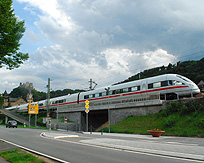 From
Basel, the DB trains follow the German side of the Rhine between the
Black
Forest
and the Alsace region of France. You could stop at the
famous Black Forest resort of Baden-Baden (Baths
at Baden-Baden), go
to Stuttgart for the car museums (see Mercedes
Museum and Porsche
Museum).
The main trains go to Mannheim where you could take a regional to Heidelberg
(see Heidelberg
Castle), Worms (see Martin
Luther at Worms), or Bad Durkheim
(see Festival
on the German Wine Route). To follow the Middle Rhine,
known for its hillside castles and the legendary Loreley rock, you’ll
go to Mainz (see Mainz
Museums), with its great Romanesque Cathedral,
as the Shelleys did.
From
Basel, the DB trains follow the German side of the Rhine between the
Black
Forest
and the Alsace region of France. You could stop at the
famous Black Forest resort of Baden-Baden (Baths
at Baden-Baden), go
to Stuttgart for the car museums (see Mercedes
Museum and Porsche
Museum).
The main trains go to Mannheim where you could take a regional to Heidelberg
(see Heidelberg
Castle), Worms (see Martin
Luther at Worms), or Bad Durkheim
(see Festival
on the German Wine Route). To follow the Middle Rhine,
known for its hillside castles and the legendary Loreley rock, you’ll
go to Mainz (see Mainz
Museums), with its great Romanesque Cathedral,
as the Shelleys did.
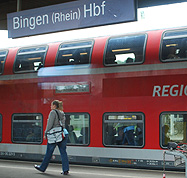
Middle Rhine Castles
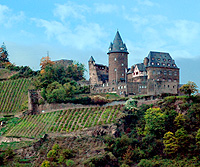 The part
of the river called the Middle Rhine is the most famous. Trains run
along either side the Rhine River between Mainz and Koblenz . The IC
and EC trains make few stops along this scenic section
of the river, at Boppard (see Boppard
Rhine) and St Goar. If you
want to stop and stay in one of the other Rhine river towns (see Rhine
Castle Hotel Oberwesel), or just get a little slower
view, the new MittelrheinBahn train (MRB) is
a new
local service train (see Middle
Rhine Train) which stops at all the small villages where
one can explore
the castles (see Castle
Rinenstein). For an even slower view, you could
take a river cruise boat trip from Mainz or Bingen to Koblenz (see KD
Rhine and Mosel Cruises). KD Cruises between Mainz
and Cologne on the Rhine and Koblenz and Cochem on the Mosel are free
with a Rail Pass.
The part
of the river called the Middle Rhine is the most famous. Trains run
along either side the Rhine River between Mainz and Koblenz . The IC
and EC trains make few stops along this scenic section
of the river, at Boppard (see Boppard
Rhine) and St Goar. If you
want to stop and stay in one of the other Rhine river towns (see Rhine
Castle Hotel Oberwesel), or just get a little slower
view, the new MittelrheinBahn train (MRB) is
a new
local service train (see Middle
Rhine Train) which stops at all the small villages where
one can explore
the castles (see Castle
Rinenstein). For an even slower view, you could
take a river cruise boat trip from Mainz or Bingen to Koblenz (see KD
Rhine and Mosel Cruises). KD Cruises between Mainz
and Cologne on the Rhine and Koblenz and Cochem on the Mosel are free
with a Rail Pass.
 After Koblenz and
Bonn, the Rhine River shore gets a little industrial as it travels
through Germany’s very developed and most densely
populated areas. Here your journey offers some choices. With Benelux
added to the pass you could head over to Luxembourg, up through the Belgian
Ardennes into the Netherlands to Amsterdam or Rotterdam. If sticking
with Germany, from Cologne with its famous great cathedral and lively
bar scene, you have a few choices, head over to Aachen and the Mosel
River (see Reichsburg
Castle
Cochem), continue along the Rhine on the
IC 2114 to Dusseldorf (see Dusseldorf
on the Rhine) or take the IC 2024
to Bremen and Hamburg.
After Koblenz and
Bonn, the Rhine River shore gets a little industrial as it travels
through Germany’s very developed and most densely
populated areas. Here your journey offers some choices. With Benelux
added to the pass you could head over to Luxembourg, up through the Belgian
Ardennes into the Netherlands to Amsterdam or Rotterdam. If sticking
with Germany, from Cologne with its famous great cathedral and lively
bar scene, you have a few choices, head over to Aachen and the Mosel
River (see Reichsburg
Castle
Cochem), continue along the Rhine on the
IC 2114 to Dusseldorf (see Dusseldorf
on the Rhine) or take the IC 2024
to Bremen and Hamburg.
Getting There and Back
Now, how to get to the beginning of this do-it-yourself tour and back home again. These days you can get a flight into one city and out from another for about the same price as a round trip to and from the same city. Use the multiple destination function on the flight search engine of your choice. You'll most likely fly into Zurich for Switzerland, for the return home, depending where you go, Frankfurt, Hamburg, Munich, Dusseldorf or Amsterdam (if you take the Benelux option).
Search for
flights on Priceline, Expedia, Travelocity
and Vayama. Most
major airlines have code share partners which operate to these airports.
For most direct flights to Zurich or Geneva, Swiss International operated
aircraft to Zurich codeshare partner with United and Lufthansa from
the German airports. KLM, Delta and Air France operate codeshare flights
to Zurich and from German Airports and Amsterdam. From London, British
Airways is
now offering fares competitive with the discount carriers, with
less baggage restrictions and to major airports.
As an alternative to multi-city flights, you could take advantage of a roundtrip air plus hotel deal to one city from the likes of Expedia or Travelocity, and use one of your travel days for a straight return trip or even a Night Train (CNL City Night Line) (see Taking the Night Train).
Fare Comparisons
If you wanted
to spend more time in Switzerland, you could get a Swiss
Pass for that portion of your tour and a single or Multi-
Country Pass for
Germany and others. The advantage of a Swiss Pass - it includes free
museums, local city tram, subway and bus transportation, and some scenic
trains that the Eurail pass does not. The Eurail pass is good on S-Bahns
in Germany but not U-Bahns or busses. Just compare the value before you
decide which is most cost effective for you. If spending more time in
Germany the multi-country Eurail pass is better, but local transportation
systems are not included.
Why a rail pass over individual tickets? Let's say you're a couple traveling together - a First Class, 6 day, 3 country Saver Pass is currently about $393 (US). For a route starting in Zurich to Lucerne ending in Hamburg, 8 legs of 2nd Class individual tickets would cost $424 for each person. Any additional excursions would be more. With a pass you can take all the side trips you want and adult rail passes are First Class standard, so finding a seat is almost never an issue. (Second Class is about as as comfortable, but can get quite crowded). The trains are really punctual, so you don't have to stop at the ticket window when your train is leaving in one minute. Some German ICE Trains require a reservation with a supplemental charge, but this is fairly rare. There'll be a notation on the schedule board. If you need to make a reservation you can go to the Travel Center in the station. Youth Passes are 2nd Class, if you're a family traveling together consider getting standard Child rate passes for kids traveling with you, rather than Youth Passes if you don't want to be stuck in 2nd Class.
Swiss
Passes and Single
Country Passesare
available in two classes. If you wanted 4 days of travel in Switzerland
with a
2nd Class Swiss
Saver Flexipass and
3 days in German Rail Pass. Every rail station in Switzerland and Germany has luggage storage, either
coin lockers or a baggage window. With a pass, if you want to get off
at a stop, stow you stuff, wander around and explore for a few hours,
have lunch, then get back on and keep going to the next stop, that's
the fun. © Bargain
Travel Europe
These articles are copyrighted and the sole property of Bargain Travel Europe and WLPV, LLC. and may not be copied or reprinted without permission.
See Also:
FRANKENSTEIN DIARIES MARY SHELLEY
RENTING
A CAR IN EUROPE
EUROSTAR
FROM LONDON TO PARIS
BENELUX RAIL PASS - BELGIUM, NETHERLANDS & LUXEMBOURG

